


By Jaron Lanier/Berkeley, California
 A perennial problem with revolution is that revolutionaries are cute in the jungle before they’ve won, but quickly become decrepit and sadistic once in power.
This is a familiar dilemma, and it is often said that the only response is constant revolution. Thomas Jefferson contemplated periodic American revolutions, though not of a violent nature. A joke that never seems far from the American stand-up comedy circuit goes, “Diapers and politicians should be changed often, and for the same reason.”
So it is natural to have sympathy for WikiLeaks. We can easily see it as the sexy revolutionary in the digital jungle. In the back of our minds we might assure ourselves that if digital-openness revolutionaries storm the capital and then turn out to be jerks, some other band of rebels can always come along to overthrow them.
But the digital jungle is different, and this is why I cannot be sympathetic to WikiLeaks. One problem is that people usually can’t see sudden digital revolutions coming. Facebook went from a cool novelty to a nearly global universal imperative in just a few years. It wasn’t as if the Red and White armies were fighting in the streets to give you a clue as to when to expect the change. Instead, it sneaked up on you. Whether you like Facebook or not, the point is that your freedom of choice was quickly reduced.
Digital power is tenacious because of what are called “network effects”. It’s hard to leave Facebook because of all the connections that would have to be broken, all the data you’d lose access to. Digital structures tend to have an all-or-nothing quality, just like a digital bit.
A design like Facebook will either fall by the wayside or become a universal standard, and if it’s a universal standard, it becomes harder to unseat than a government.
So when you look at a digital phenomenon starting to take off, you must not assess it as if it is the cute revolutionary in the jungle. You must think of it as the politburo. If a digital system turns out to be a winner, it won’t have time to grow up before it comes to power.
Since WikiLeaks is relatively small, it is cute, still in its jungle phase. But what if it turns into Facebook? I am not saying that it is certain to become so influential, but the potential is there. The scenario I fear for WikiLeaks is this: General communication in governments and companies will become phony and banal, as it is on Facebook, except when it’s pointlessly nasty and gossipy, as it also is on Facebook. But it will not be diplomatic.
Meanwhile, genuinely consequential communication will take place hidden within a bunker, close to a powerful computer server that outsiders cannot penetrate. This is the new pattern of the distribution of power among human beings. Digital technology has re-patterned human influence.
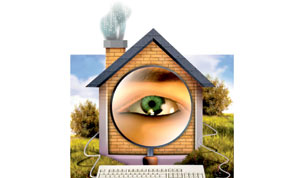
Certain big computers on the Internet have become all-seeing eyes, gathering dossiers on the rest of the world. Some of these are called social-networking servers and some are called hedge-fund servers, and now we have the secret encrypted core of the WikiLeaks server to contend with as well.
But in all cases, small groups of people gather close to these special servers and speak in secret. When this happens, wealth and power are determined by proximity to the right computer. Decent government seems to persist only when there is a strong middle class, and it is sadly the case that computer networks have been used to redistribute wealth and power away from the middle class, at least in the United States and Europe.
The mechanisms by which the middle class in the United States has been undercut usually involved computer networks. It started with Wal-Mart, the giant retailer, using computer networks to fine-tune distribution systems so perfectly that it no longer mattered where something was manufactured. It’s hard to be too upset with this development, since it also funded the peaceful ascendance of China, a process that has gone more smoothly, at least so far, than anyone had dared to hope.
But then the same principles were applied directly to finance, and that allowed financiers to create profits without risk to themselves, which is precisely the same thing as concentrating wealth in a new aristocracy. There are new aristocracies in finance, but also in culture. Publishers, music companies and movie studios have become subservient to the companies that run the central cultural computers, like Apple, Facebook, and Amazon.
(This is perhaps a good juncture to interrupt my warning about WikiLeaks to say that computer technology is essential for human survival, even if it is often being used badly. While it is not in the scope of this small warning to describe how things could be better, I do want to assure the reader that compassionate uses of information technology exist and are not occult or obscure.)
If the systems promoted by WikiLeaks should bloom, then a similar new kind of power will appear in politics. What are these aristocracies like? One word says it: nerdy. The whole world is getting a case of Asperger’s syndrome.
I am a nerd and I like nerds, so it’s tempting to entertain the thought that a world run by nerds would not be so bad. If only that were so. What actually happens when computers are used to concentrate power is that power becomes over-concentrated. The only braking mechanism on accumulation of wealth by financial computers was the imminent failures of the countries that support the currencies. So now one hears nerd financiers speaking among themselves of creating new extra-governmental currencies.
Another thing that happens is that people who didn’t used to be nerds have to learn to act like nerds to get by. Teenagers learn to represent themselves as data on a social-networking site, and so to live their lives as to fit into the categories embedded in the system.
The term “advertising” is used to describe the process of access and influence-buying in a world of computerised power. While you arduously tend your fake self on Facebook, the company compiles a secret dossier about you and everyone else so that access to you can be sold to political campaigns, teeth-whiteners, or finance hucksters.
You are the product, not the customer. Meanwhile, the things you might offer online - your creative work, your opinions, your advice - are all made worthless in terms of real money.
This is all to say that the WikiLeaks design, if it gets big, would not promote general openness, but a redistribution of where secrets would be kept. It would also make secrets more secret.
In a world remade by WikiLeaks, the government and corporate activities you could see because of the celebrated openness would be similar to the openness in social dynamics you get to see on Facebook. Sometimes interesting, occasionally touching, useful, and substantial, but overall banal.
The real news, the real power, would be hidden in a descendant of Julian Assange’s encrypted server. Computers immunise people who use them for power. When financiers use computers to concentrate wealth without taking on risk, they don’t go to jail. Digital information is perfectly sterile, fungible, erasable and concealable.
WikiLeaks as a small rebellious group is one thing, but as a prototype for larger events, it is creating the prototype for digital immunisation in politics. The dictators of the world are watching WikiLeaks, and while they might not like the occasional Facebook-like embarrassments that emerge about them during these early stages, they are also learning new tricks. If someone like Assange can accumulate power with a digital strategy, what else might be done?
I dread the answers to this question. — The Free Lance-Star/MCT
*** Jaron Lanier is a computer scientist, composer, visual artist, and the author of You Are Not a Gadget. Readers may send him e-mail at [email protected]