


By Shereen El Feki/
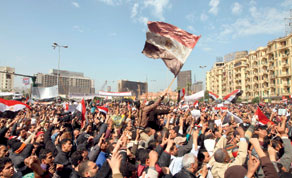
Egyptian anti-government demonstrators waving their national flag as they gather at Cairo’s Tahrir Square yesterday
After days of trying to get through, I finally reached my close friend A by phone early last week. In her early forties, she lives with her husband and three kids in a lower middle class area of Maadi, a suburb in the south of

“I don’t sleep before
A and I met in happier times, in 2008 when I moved to
I moved back because I wanted to understand what makes Egyptians tick, and in the process, better understand my own identity as an Arab and a Muslim — pressing questions in a post-9/11 world.
To those who know
Only 12% of eligible youth were registered to vote, fewer than half even talked about politics and less than 5% participated in any sort of organised activity. Most young people, it seemed, had gone offline from their country, young men in particular focussed on finding a job to make enough money to get married and move out of their parents’ home.
“I always used to say before, this generation has nothing to do but stay on their computers and play,” Mahmoud Hadi told me. He’s a retired army-general in his 50’s, who lives with his wife and two children around the corner from A.
“But I was very wrong. At the beginning I was very surprised by the demonstrators, the decency, the civilised way they presented their ideas. This generation has proved to me that they have plans for the future, and they know how to work for it.”
In just over a week, Egyptian youth have gone from being layabouts to leaders in Hadi’s eyes. A too has seen the change; she often fretted about her 20-year-old’s lack of maturity. Not any more, though. “They are guarding the house, both my sons,” A told me. “This week, they have become men.”
For the gerontocrats of Mubarak’s regime, this sudden coming of age of Egyptian youth is not exactly good news, but if this new sense of empowerment and responsibility can be sustained, it is one of the most significant developments of these days of turmoil.
Yasmine, Hadi’s 21-year-old daughter, is living proof. Just back from the “million man march” in
This newfound solidarity is another important outcome of recent events.
These demonstrations have brought people together in a way that few could have imagined a year ago. “I was protesting, and on my right there was a man who cannot walk. He was over 80, and (so poor) he is not having shoes. And on the other side, there is a famous journalist. I am just a small student, and he is a journalist and this poor man, we tried to help him to walk with us,” Yasmine recounted.
There is similar unity, at least among these families in Maadi, on Egypt’s key problems. “Better education, helping youth to find work, to marry without a lot of financial burden, also for my husband to find better work, better salary, these things we hope,” says A of her wishlist for change, speaking for not just for her neighbours, but most Egyptians as well.
While both families agree on what’s wrong with Egypt, they differ sharply - in increasingly heated arguments - in whom they trust to put it right. A and I had never talked politics, because we were never quite sure who was listening. But I had assumed, because of her everyday economic struggles, and because of her job at the American University of Cairo, a comparative bastion of liberal values in Egypt, that she would be all of Mubarak’s departure.
But I would be wrong. “I love Mubarak. I respect him a lot. Yes, we have troubles, but I don’t think he is only to blame.” A praises Mubarak for the 30-years of peace he has brought Egypt, protecting it from invasion by America and/or Israel. With him gone, she fears “we will be very weak like bread, everyone will come and eat us.”
She craves stability; now that Mubarak has changed his cabinet, that’s enough transition for her. “We should not say to our father, Mubarak, go leave the house, because he is our house.”
Meanwhile, I assumed Hadi, ex-general turned civil servant, would support his former commander-in-chief. But I was in for a surprise there too. “I have very defined requirements: reform the house of representatives, plan for clean and transparent elections and put an end to a deeply-rooted corruption from top to bottom.” But it could only begin, for Hadi, with the removal of the Mubarak.
The very fact that Hadi and his family, who oppose Mubarak, are willing to see their names in print is one measure of the seismic shift now shaking Egypt. But it is hard to stay silent at the scenes unfolding by the hour. Since these protests began, Egyptians have regained a sense of purpose and a passion for the future of their country -- for and against the current regime. That’s a victory for Egyptians, no matter how this crisis ends. -Global Experts/UNAOC
lShereen El Feki is a writer, broadcaster and academic. She is an expert on social change in the Arab region, particularly as it relates to sexual and reproductive life and is a UN Global Expert
l Global Experts (www.theglobalexperts.org), a project of the United Nations Alliance of Civilisations