


By William Maclean/
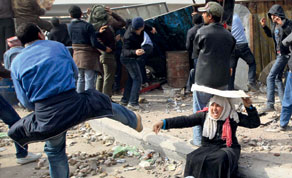
A woman opposition supporter takes shelter while providing water during rioting with pro-Mubarak demonstrators near Tahrir Square in Cairo yesterday
Will

A senior former Western defence official said the longer the unrest went on, the more pressure would build in the military to see President Hosni Mubarak as a liability to be ditched.
But whatever route the 468,000-strong armed forces choose to go, their action only stood a chance of being effective if it enjoyed broad support across senior and junior ranks, and the unity of the officer corps remained unclear, analysts said.
Unity of the ranks “is the million dollar question in situations like this,” said the senior former official.
“When you have to separate two factions, that is when it becomes really tricky.”
If officers came to the conclusion that they could not stop clashes between protesters and loyalist demonstrators, “the pressure on him (Mubarak) to go will increase.” “They are under huge pressure whichever way they turn,” said Fawaz Gerges, Professor Middle Eastern Politics at the London School of Economics.
The army had been placed in a tough position by Mubarak’s refusal to bow to pressure and resign, and found itself in an even worse predicament when violence erupted in central
Mubarak pledged on Tuesday to step down, but only in September at the end of his current term. Protesters have vowed to stand firm until the 82-year-old leader is gone.
Catherine Ashton, the European Union’s foreign affairs chief, said on Thursday she was “deeply concerned” about the violence that had taken place in
On Monday, the army called protesters’ demands legitimate and pledged not to open fire. But on Wednesday, troops stood by as Mubarak loyalists charged
Omar Ashour, an Egyptian political scientist, said his impression was that Defence Minister Hussein Tantawei was not popular in the lower ranks, and certainly did not enjoy the esteem of his predecessor AbdalHalim Abu Ghazala.
He said his sense was many middle ranking officers tended to fear the senior ranks, and “the senior ranks fear them back.”
“Don’t forget that the lowest ranks in the army are treated as bad as the lower classes in society. There is a lot of sympathy in the lower and middle ranks with the protesters.”
He said demonstrators had told army officers on the streets that if they received orders to shoot protesters, they should demand those orders in writing. “Make no mistake, there will be trials when this is all over, and it is usually the junior ranks who are used as scapegoats,” Ashour said.
Egyptians tend to respect the military, less linked with daily repression than police and security agencies.
Ashour said he had been astonished to see state television showing a visit Tantawi had made to junior ranks in which he had patted soldiers on the cheeks and smiled.
“It shows a sign of weakness, because he is sucking up to the lower ranks,” said Ashour.
“This man is one of the most arrogant and uncompromising figures in the regime. People are scared of him. I never saw this guy smiling before and getting nice and cosy with the soldiers.”
Gerges said the army was neither a monolith nor “an island unto itself” and its various constituent parts would increasingly have to recognise the strength of popular opposition to Mubarak.
“What little we know about the junior ranks suggests that they are closer to the sentiment on the streets than the senior ranks,” he said.
The former western defence official said Army chief of Staff Sami Enan would play a pivotal role in the army’s next move.
He said: “What is crucial is how much he is really in touch with the strength of feelings of the people on the streets.”
“I think the fact that Mubarak wants to stay until the end of his term must really leave a big question over him. The more this goes on and the longer people are on the streets, the stronger those feelings will grow (that he should go).” - Reuters