


Shanta Pathak, who has died aged 83, made a momentous decision in a tatty

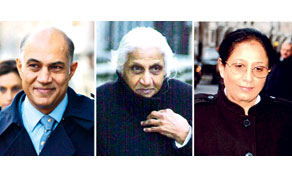
Shanta Pathak (middle) and her son Kirit Pathak (left) and sister Chitralekha Mehta
The Pathaks had already left two countries to escape poverty and prejudice, and had no illusions about the challenge of starting again in 1950s
Her optimism and persistence sustained Laxmishanker’s business sense, along with her cookery skills, which lay behind the first, simple jars and packets of Pathak products. British taste took a long time to come round, but by the late 50s they had saved enough money to buy a small shop behind Euston station in central London. They opened another in Bayswater, west London, in 1961.
Commercial progress remained modest until 1972, but that year some 50,000 Ugandan Asians arrived in the UK, expelled by Idi Amin. Spurred by Shanta, the Pathaks bid for the contract to supply food to the refugee camps. They won and were praised for their exemplary work, which included giving advice and help on settling in the UK.
Thousands of the new immigrants found their own entrepreneurial feet in catering and repaid the Pathaks by turning to them for supplies. By the late 70s, the family was employing 500 people at a converted mill in Brackley, Northamptonshire, and supplying more than 7,500 British restaurants and many others in 40 countries.
The Pathaks’ son Kirit, the oldest of four boys and two girls, took over control of the firm in 1976. Educated initially at a Catholic school, which gave him an Irish accent and a brief childhood ambition to be pope, he and his wife, Meena, a food technology graduate, raised turnover to £55mn before selling the firm to Associated British Foods in 2007 for an estimated £105mn.
A devout Hindu, Shanta shared her husband’s passion for understanding between ethnic communities in the UK and was closely involved in the family’s charitable work. She was not able to prevent family quarrels, however, and was devastated when her daughters sued in 2004 to claim a larger share of the firm.
A settlement was reached, but she did not forgive them for obliging her to give evidence in court.
Kirit described his mother as “a huge inspiration, full of charisma and spirit” whose flair had helped at every stage of the Pathaks’ story. Born in Gujarat, India, she sailed to east Africa as a child when her parents sought a way out of poverty, and met Laxmishanker there.
She deferred to him in business, superficially, but was well aware of the value of marketing and persuaded him to drop the “h” from their name - a matter of some pride - to make their products easier to pronounce for the growing non-Asian British market. She also helped to tempt the film-maker Roland Joffe to make memorable TV advertisements which drew on British sentiment for the Raj.
Always the men’s equal, she was effortlessly superior in the place that mattered most to the Pathaks’ success. Kirit said: “My mother was at her happiest in the kitchen and the fact her secret family recipes have remained largely unchanged speaks for itself.”
Laxmishanker died in 1997. Shanta’s children survive her. — Guardian News and Media
*** Shanta Gaury Pathak, cook and entrepreneur, born February 2, 1927; died November 23, 2010.