


AFP/Phnom Penh
Southeast Asian states want a UN maritime convention to be the basis for settling competing claims in the South China Sea, a draft document showed yesterday.

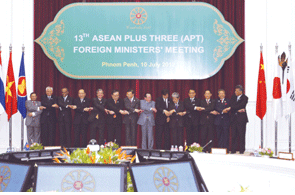
Foreign Ministers hold hands as they pose for a photograph during the 13th Asean Plus Three (APT) Foreign Ministers’ meeting at the office of the Council of Ministers in Phnom Penh yesterday
Southeast Asian foreign ministers are meeting in Cambodia to draw up a long-delayed code of conduct to be signed by them and China aimed at easing friction in the disputed regional hotspot.
The draft document outlining Asean’s position, which was seen by this agency, called on all sides to “undertake to resolve territorial... disputes in the (South China Sea) by peaceful means in accordance with international law, including UNCLOS”.
UNCLOS is the UN Convention on the Law of the Sea, an international treaty that sets limits on how much of a neighbouring sea a nation can consider as their territorial waters or exclusive economic zone.
China is a signatory to UNCLOS, but experts say its claim of essentially all of the South China Sea, home to vital shipping lanes and believed to be rich in oil and gas deposits, would fail under its provisions.
Taiwan and Asean members the Philippines, Vietnam, Brunei and Malaysia all make rival claims on areas of the sea, where tensions have mounted recently.
Beijing voiced opposition to the row being discussed at this week’s Asean Regional Forum, a security-dominated meeting beginning tomorrow. The US, Russia, Japan and Canada will join the meeting, among others.
“This South China Sea issue is not an issue between China and Asean, but between China and some Asean countries,” foreign ministry spokesman Liu Weimin told reporters.
“Hyping the South China Sea issue... is against the common aspirations of the people and the main trends of the time to seek development and cooperation, and is an attempt to take China-Asean relations hostage,” Liu added. The issue is not on the formal agenda for the Forum, but is expected to be raised informally by members including Vietnam and the Philippines and will be discussed during a separate Asean-China dialogue today. The draft Asean document on the code of conduct proposes that all sides attempt to settle disputes first within the framework of the Treaty of Amity and Cooperation, an Asean-centred pact that bans the use of force to settle disputes.
Failing that, parties may resort to the “dispute-settlement mechanism provided in international law including UNCLOS”, according to the draft, which also calls for cooperative activities to build trust and confidence. Asean, currently chaired by Cambodia, is aiming for a code to be hammered out this year, but analysts said this could take longer given the opposing positions. China rejects any international intervention in settling the overlapping territorial claims and wants to discuss the differences bilaterally with concerned countries.
Pavin Chachavalpongpun, associate professor at Kyoto University’s Centre for Southeast Asian Studies, said Asean members were concerned about bilateral negotiations.
“This is because they feel that they will not have enough bargaining power in dealing with a bigger China,” he said.