


 |
| Aung San Suu Kyi |
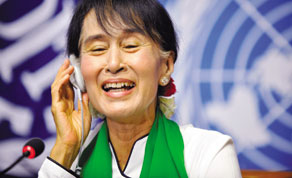
Suu Kyi, who arrived at the UN offices in Geneva to flowers and applause, appealed for the investment in a speech to delegates at the International Labour Organisation conference.
“It’s not so much joblessness as hopelessness that threatens our future,” she said, making her first visit to Europe in 24 years.
“Unemployed youth lose confidence in the society that has failed to give them the chance to realise their potential. Foreign direct investment that results in job creation should be invited,” she added.
Suu Kyi also spoke of the plight of migrant workers from Myanmar in Thailand, calling for co-ordinated social, political and economic policies “that will put our country once again on the map of the positive and the successful.”
She told her audience she was “profoundly moved” by the “totally unexpected, very warm welcome” she had received as she began a five-country tour which will include a speech in Oslo to accept the 1991 Nobel Peace Prize she was unable to receive at the time.
Her visit marks a new milestone in the political changes that have swept the country formerly known as Burma since decades of military rule ended last year, bringing to power a new quasi-civilian government.
The Myanmar opposition leader has spent the last quarter of a century either confined to her Yangon home on the orders of the ruling military junta or too afraid to leave the country in case she would not be allowed to return.
She also told reporters that she thought French and US oil giants Total and Chevron, long a target of human rights activists for their activities in Myanmar, should continue to operate there.
“I find that Total is a responsible investor ... it is sensitive to human rights,” she said after her speech.
The previous “concerns” about their support for the junta were a thing of the past, and she was “not going to persuade Total or Chevron to pull out” of Myanmar, especially when there was such a need for “democracy-friendly investment,” she said.
Switzerland is the first stop on a tour of more than two weeks that will take her to Norway, Britain, France and Ireland.
Myanmar President Thein Sein has recently overseen a series of reforms. They included releasing hundreds of political prisoners, signing peace pacts with armed rebel groups and welcoming Suu Kyi’s National League for Democracy party back into mainstream politics.
The ILO, a UN agency which draws up and monitors international labour standards, has sought for years to rid Myanmar of the practice of forced labour which it says is widespread there.