


 |
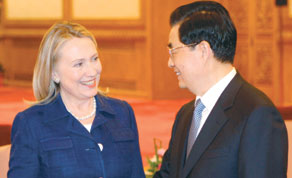
| US Secretary of State Hillary Clinton shakes hands with China’s President Hu Jintao during a meeting at the Great Hall of the People in Beijing yesterday |
The US said yesterday that China had indicated it would let blind activist Chen Guangcheng and his family leave the country soon, raising hopes of a resolution to a damaging diplomatic crisis.
State Department spokeswoman Victoria Nuland said China would expedite travel documents for the rights campaigner, who escaped house arrest and fled to the US embassy, where he spent six days before emerging Wednesday.
“The Chinese government has indicated that it will accept Chen’s applications for appropriate travel documents,” Nuland said in a statement.
“The US government expects that the Chinese government will expeditiously process his applications for these documents. The US government would then give visa requests for him and his immediate family priority attention.”
Nuland said Chen had been offered a fellowship by an American university, where he could be accompanied by his wife and two children.
The US statement appeared to be deliberately vague in hopes of giving China a face-saving way out of the crisis. Officials declined to give a timeframe or to say whether they had firm assurances from the Chinese government.
Beijing earlier said Chen was free to apply to go abroad, after the activist said he feared for his and his family’s safety in China and wanted to go to the US to study.
US Secretary of State Hillary Clinton said she was “encouraged” by that development in the affair, which erupted ahead of her arrival in Beijing for annual talks that have been overshadowed by the drama.
“Progress has been made to help him have the future that he wants. We will be staying in touch with him as this process moves forward,” Clinton said.
The activist, who spent four years in jail after exposing forced abortions and sterilisations under the “one-child” policy, unleashed a diplomatic furore with his flight from his home in northeast Shandong province.
US officials said Chen, 40, left the embassy after Beijing pledged he and his family would be treated “humanely”, but since then he has said he fears retribution by Chinese authorities.
“I am in great danger... I hope the government will respect the commitments to guarantee my rights agreed to between China and the US,” he said by telephone earlier yesterday from the hospital where he is being treated.
During interviews with Chinese officials in hospital on Thursday and yesterday, he made “detailed allegations” about abuse under house arrest, a US official said on condition of anonymity.
The unravelling of the deal prompted the US to renew talks with Chen to try to establish the next move for the activist, who has said he does not want to go into permanent exile but is seeking a period of rest abroad.