


 |
|
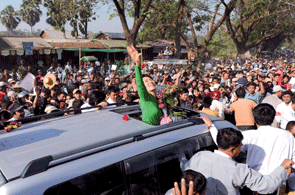
Myanmar opposition leader Aung San Suu Kyi waves as she crosses a crowd of supporters while arriving for a political rally as part of her electoral campaign at a stadium in Pathein, some 200kms west of Yangon yesterday |
Huge crowds clogged the streets of Pathein to see the democracy icon, whose decision to contest the April 1 vote is seen as a key sign of reform in a country that emerged from nearly half a century of direct army rule last year.
Local people waved pictures of the Nobel laureate and held out flowers, while saffron-robed monks waved the flag of her National League for Democracy (NLD) party.
“We all need to work for free and fair elections,” Suu Kyi told supporters packed into the town’s sports stadium. “I saw many young people on my way here—they are the force, the future of the country.”
Suu Kyi’s latest foray outside of Yangon comes after a planned two-day visit to the central city of Mandalay on Saturday was postponed because the venue offered by the authorities was too small.
In her first campaign trip to the southern city of Dawei in late January, streets were flooded with tens of thousands of local people.
Suu Kyi’s participation in the April vote is likely to lend legitimacy to Myanmar’s parliament, which is dominated by former generals.
The April polls, held to fill places vacated by those elected in 2010 who have since become ministers and deputy ministers in the government, will mark the first time Suu Kyi has been able to directly participate in a Myanmar vote.
The NLD is running for all 48 seats up for grabs in the polls and Suu Kyi is standing in a rural constituency near Yangon, but the seats available are not enough to threaten a majority held by the army-backed ruling party.
A new regime has surprised observers with reforms including welcoming the NLD back into the political mainstream, signing ceasefire deals with ethnic minority rebels and releasing hundreds of political prisoners.
The nominally-civilian government came to power following November 2010 elections that were marred by widespread complaints of cheating and the absence of Suu Kyi, who was under house arrest at the time.
Meanwhile, a top Myanmar official yesterday proposed a rise in civil service wages to combat widespread graft in a move likely to prove popular as the country heads towards landmark by-elections.
Lower House speaker Shwe Mann, a former junta number three who is considered one of the country’s most influential reformers, said pay for government workers was not enough to cover “basic daily expenses”.
He said the raise, which will be debated by parliament, should come into effect on April 1, the same day that the country holds by-elections that will be contested by opposition leader Suu Kyi for the first time.
“We must give a high enough salary to school teachers, the police, soldiers and government staff,” he told MPs, adding that otherwise staff would supplement shortfalls in their income in ways that would damage their “character”. Agencies
US announces limited lifting of sanctions
The United States lifted one of its many sanctions against Myanmar in recognition of recent positive moves toward political reform in the country after decades of direct military rule. US Secretary of State Hillary Clinton signed a partial waiver of restrictions imposed on Myanmar, formerly known as Burma, under the Trafficking Victims Protection Act, the State Department said in a statement. The waiver will allow the United States to support assessment missions and limited technical assistance in Myanmar by international financial institutions (IFIs) such as the World Bank, the Asian Development Bank, and the International Monetary Fund. Clinton in December became the first US secretary of state to visit Myanmar in more than 50 years, in a trip that gave her “some grounds for encouragement,” and where she met its leaders and pro-democracy icon Aung San Suu Kyi.