


 |
|
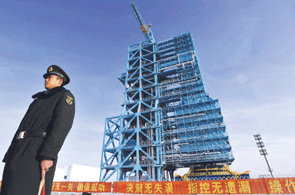
A soldier stands guard in front of an upgraded Long March 2F rocket carrying the Shenzhou-8 spacecraft at the Jiuquan Satellite Launch Centre in northwest China’s Gansu province yesterday |
The spokeswoman for China’s space programme, Wu Ping, said a rocket will lift the unmanned Shenzhou 8 spacecraft into orbit from northwest China today at 2158 GMT, preparing the way for the spacecraft to dock with the Tiangong 1, an experimental module launched on Sept 29. The rendezvous and docking exercises between the two vessels are part of China’s effort to develop the technological and logistical skills needed to run a full space lab that could house astronauts for long stretches.
The next step, planned for 2012, will entail similar exercises with at least one mission carrying astronauts onboard, Wu told a news conference at the launch site in the Gobi Desert, according to a transcript on an official news website (www.china.com.cn).
“Next year, we will carry out the Shenzhou 9 and 10 flight missions, and they will also carry out rendezvous and docking tests with the Tiangong 1,” said Wu. “According to the mission plans, at least one of the two flights next year will be manned,” she added.
Beijing is still far from catching up with the established space superpowers: the US and Russia. The Tiangong 1 is a trial module.
Russia, the US and other countries jointly operate the International Space Station, to which China does not belong. But the US will not test a new rocket to take people into space until 2017, and Russia has said manned missions are no longer a priority for its space programme, which has struggled with delays and glitches.
China’s impending unmanned tests will help determine whether a modified version of the Shenzhou spacecraft “is suited to the needs of manned space travel,” said Wu
Bringing together craft in the vastness of space is one of the key skills needed for an advanced aeronautic programme that includes a space station. Collisions can be costly, even fatal.
“It is quite difficult and risky to join together two vehicles travelling at high speeds in orbit, with a margin of error of no more than 20 centimetres,” Wu said.
Wu said crew members have been selected for the possible space missions next year, including two female astronauts. Reuters