AFP/Yangon
Myanmar’s democracy champion Aung San Suu Kyi yesterday pledged to work for the release of the country’s remaining political prisoners following an amnesty that left many key dissidents behind bars.

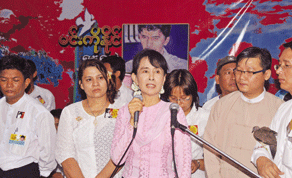
Myanmar democracy icon Aung San Suu Kyi delivers a speech during a ceremony marking the birthday of imprisoned student leader of the 1988 uprising Min Ko Naing, at a monastery in Yangon yesterday
The regime pardoned 227 imprisoned critics, according to Suu Kyi’s party, but kept most of its roughly 2,000 political inmates locked up, including key figures involved in a failed 1988 student-led uprising.
“Many (student leaders) have still not been freed from their imprisonment. We will continue our struggle for their release,” Suu Kyi told supporters at birthday celebrations for Min Ko Naing, an 88 Generation leader serving a 65-year jail term. “Why do I want the release of political prisoners? I want our country to become really free,” Suu Kyi said at a ceremony at a monastery in Yangon.
Min Ko Naing, whose prison term stems from his role in the 2007 monk-led protests known as the “Saffron Revolution”, saw in his 49th birthday in Kyaing Tong prison in Shan State, northeast Myanmar.
Suu Kyi’s National League for Democracy (NLD) said it was “frustrated” by the relatively small number of political detainees included in an amnesty for more than 6,000 prisoners last week.
Famous satirist Zarganar, who goes by one name, was among those released and has since spoken out against the regime’s decision to leave many other critics locked up.
He now plans to organise a group of actors and comedians to visit jailed dissidents held in prisons around the country.
“I will try to visit my friends who are still in the prisons,” he said at the Yangon ceremony.
Zarganar, who was held at Myitkyina prison in Kachin State in northern Myanmar, had been serving a 35-year sentence following his arrest in 2008 after organising deliveries of aid to victims of Cyclone Nargis, which left 138,000 dead or missing.
He said he would leave parcels for political detainees if he was not allowed to see them.
“They will be happy if they know that I have travelled to visit them in person, even though we cannot see each other,” he said.
The fate of political prisoners in Myanmar is a key concern of western governments that have imposed sanctions on the isolated nation.
Some observers have said the amnesty could be one of several by a regime that appears eager to end its international isolation but is wary of potential unrest.