


 |
|
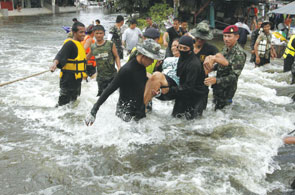
Thai soldiers carry a woman through a flooded street in Pathum Thani province yesterday |
Fears for the capital Bangkok appeared to have eased as authorities battled to contain Thailand’s worst flooding in decades, which has claimed over 300 lives, swallowed homes and shut down industry.
But Prime Minister Yingluck Shinawatra warned: “The original budget to support the recovery of both the industrial and agricultural sectors is not likely to be enough.”
Speaking at the disaster response headquarters at Don Muang Airport in northern Bangkok, she said the budget, which does not include water management costs, was now expected to exceed 100bn baht ($3.3bn).
The previous budget was $2.6bn.
Three months of heavy rains have deluged about one third of Thailand’s provinces, with floods -- several metres deep in places -- forcing tens of thousands of people to seek refuge in shelters.
The flooding has waterlogged major roads and hundreds of factories, disrupting production of cars, electronics and other goods in the kingdom, with another major industrial estate succumbing to the floods yesterday.
Finance Minister Thirachai Phuvanatnaranubala said the floods across the country were likely to cut economic growth this year by up to 1.7%, according to estimates from the Bank of Thailand and the National Economic and Social Development Board. The previous estimate was 0.9%.
Forecasters at the University of the Thai Chamber of Commerce have estimated the cost of the floods to the Thai economy at about 150bn baht ($4.9bn) -- roughly 1.3-1.5% of annual gross domestic product.
Thailand yesterday gave the go ahead to a hefty minimum wage hike, Labour Minister Phadermchai Sasomsab said, although it postponed the measure until April 2012 in response to pleas from the flood-hit industrial sector.
Meanwhile, the Thai government is pushing ahead with a big rise in the minimum wage despite appeals from industry to shelve the plan to help companies cope with financial losses after the worst floods in half a century devastated parts of the country.
At a meeting of a tripartite wage committee yesterday, employers were outvoted by government and worker representatives and a minimum daily wage of 300 baht ($9.70) was set for Bangkok and six other relatively well-off provinces, an increase of about 40%.
However, the start date has been pushed back from Jan 1.
“This will be effective on April 1, 2012 because of the flooding,” Labour Ministry permanent secretary Somkiat Chayasriwong told reporters.
The rest of Thailand’s 77 provinces will also get a rise of 40%, but that will leave the minimum below 300 baht.
A rise in the minimum wage to a uniform 300 baht around the country was one of the main policies of the party of Prime Minister Yingluck Shinawatra in July’s election. It would have meant an increase of 90% in some poorer areas. A 300 baht daily wage is five times higher than the minimum in Vietnam and 2.5-4.6 times that in Indonesia, according to Kasikorn Research Centre. A rice-based meal for one person costs about 37 baht from a Bangkok street-vendor.
Yingluck apologised for authorities’ inability to protect Navanakorn industrial estate after water overwhelmed defences at the site, which houses over 200 factories for local and foreign firms and employs nearly 200,000.
Hundreds of locals helped soldiers trying to protect the estate -- Thailand’s oldest -- with sandbags but were told to evacuate as water began pouring into the area in Pathum Thani province, located near Bangkok.
One factory worker said that the area was flooded “in just a few minutes”.
“I thought this estate could hold out against the water so I helped in another place... then I heard about evacuation here so I ran back to pick my motorcycle,” another worker, Sopha Srisan, said.
Flood Relief Operation Command (FROC) said there was up to two metres of water in some areas of Navanakorn but expressed continued confidence that the capital would be spared. A spokesman said the Thai premier had ordered a third protection dyke, to be built in the northern outskirts of the capital “to assure Bangkokians”.
Authorities have so far prevented major flooding inside the capital by diverting water through a complex system of rivers and canals around the city.
Conditions in Bangkok remained mostly normal and Suvarnabhumi Airport -- the capital’s main air hub, which has flood walls several metres high -- was operating as usual.
The Thai Air Force said it was moving 20 of it’s 30 planes out of Don Muang Airport as a precaution.Yingluck has asked the military to take charge of the emergency response in five provinces, including the low-lying historic city of Ayutthaya, which has been under water for over a week.
Thai authorities said water levels were receding in Ayutthaya, which lies about 80 kilometres upriver from Bangkok and has seen its ancient World Heritage temples and all five of its industrial estates swamped. Agencies