


 |
|
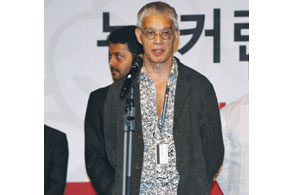
Filipino director Loy Arcenas: his languid family drama Nino shared the top award with an Iranian film. Nino focuses on how people are pulled apart by greed. An acclaimed New York-based production designer and theatre director, Arcenas said he had turned to cinema because the medium allowed him to explore the nature of human relationships. “I have always been interested in chronicling human relationships and that is what I have tried |
The Busan International Film Festival (BIFF) rolled out the red carpet to a cast of A-list stars and showcased more than 300 productions from all over the world - but it has been the local films that have left cinema-goers buzzing.
“The standard of productions we have seen here this year has been outstanding,” said Chinese director Yonfan, in town to head the jury for the festival’s main New Currents award.
“It is an indication that Asian cinema is very healthy and there is a vast collection of very talented people out there making films today.”
That talent pool was reflected in the 13 films from 12 countries which contested this year’s New Currents award, which offers two prizes of $30,000 and is open to first- and second-time Asian directors.
While the money went to Iranian director Morteza Farshbaf’s gripping Mourning and the languid family drama Nino from Filipino Loy Arcenas, the field was full of films that belied their makers’ collective inexperience behind the camera.
The Mangesh Hadawale-directed Watch Indian Circus picked up the festival’s audience award after delighting packed houses with its mix of comedy and savage social commentary as it followed the ups and downs of an impoverished couple as they find the funds to treat their children to a night out.
Away from the main award, Korean cinema was out in full force, with a wildly diverse collection of productions.
They included everything from the local box office smash Sunny - a reflection on chances missed and taken in life - to the bleak-but-brilliant animation The King of Pigs, a nasty look at troubled modern youths that shows the genre can be worked for more than just light entertainment.
The 16th edition of BIFF began with the opening of the $140mn Busan Cinema Centre, a 30,000 square metre complex that boasts a spectacular LED-lit roof and a 4,000-seater outdoor theatre.
Festival organisers hope the facility will establish the city as a hub for both the screening and development of Asian film.
The event opened with the heart-warming romance Always, with Korean director Song Il-gon’s film making its world premiere.
The night was almost stolen by local starlet Oh In-hye, whose “barely there” dress left the opening night audience with mouths agape and ensured her name was briefly the “most-searched” on the Internet in South Korea.
But the festival soon got down to the serious business of screening films, with 307 productions on show for a total audience of 196,177 people.
Among other highlights for fans was a master class held by French director Luc Besson, here to promote his biopic of the Myanmar activist Aung San Suu Kyi The Lady, along with the film’s star, Malaysian actress Michelle Yeoh.
Besson gave an intriguing insight into the workings of the modern film industry and declared he could only survive by “working with Hollywood but never in Hollywood”.
Yeoh’s measured and mesmerising performance in The Lady had her audience whispering the word “Oscars” and the actress herself said it was a rare opportunity to play such a complex character.
“There are not many icons in our times, let alone a woman and let alone an Asian woman, so I am justly deeply grateful that I was given the chance to play this role,” she said.
Several elaborate 3D productions including Japanese maverick Takeshi Miike’s slow-burning Hara-Kiri: Death of a Samauri showed what can be done when you have money at your disposal.
But two Korean thrillers shot with 3D technology - Persimmon and A Fish - were well received by critics and audiences alike, showing what can also be done on a shoestring budget.
The festival’s other main prize, Flash Forward, is open to young filmmakers from outside Asia and its $30,000 prize was picked up by first-time Italian filmmaker Guido Lombardi’s La Bas - A Criminal Education.
“I think what makes this event unique is the audience involvement,” said the director. “We had about 100 people stay for a Q&A after our first screening and they seemed to know all about us and all about cinema. There seems to be a real appreciation for cinema everywhere you go.”
It was a sentiment shared by the legendary French actress Isabelle Huppert - the Cannes award-winning star of The Piano Teacher (2001) - here to screen her family drama My Little Princess. AFP