


 |
|
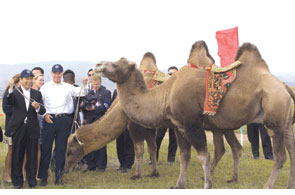
US Vice President Joe Biden (second left) and Mongolian Prime Minister Sukhbaatar Batbold look at camels during the official welcome ceremony in Ulan Bator yesterday |
The US vice president met Mongolia’s President Tsakhia Elbegdorj in a ceremonial ger, or traditional tent, set up on the fifth floor of the government headquarters in the country’s rapidly developing capital, Ulan Bator.
Biden is the most senior American leader to visit Mongolia since 2005 and his trip comes months after Elbegdorj promised to give US companies a role in his country’s booming energy sector.
“Today, Mongolia is not just a shining example for other nations in transition, but it’s an emerging leader in the worldwide democratic movement,” Biden said after meeting the country’s leaders.
“A responsible actor on the world stage and a close friend and partner of the US – none of that is an exaggeration. It’s literal.”
Sandwiched between China and Russia, Mongolia has traditionally pursued a careful foreign policy that does not alienate its giant neighbours.
But it has also sought closer ties with the US, and Biden yesterday thanked Mongolian Prime Minister Sukhbaatar Batbold for the nearly 400 troops his country is deploying in Iraq and Afghanistan.
Mongolia is opening up its vast coal reserves to foreign investors, hoping to stimulate growth and pull thousands of people out of poverty in the mineral-rich but still underdeveloped country.
Last month, US mining giant Peabody Energy said it was among the firms chosen to help develop a section of the highly coveted Tavan Tolgoi coal mine in the Gobi desert, although later reports said the deal was still under negotiation.
Tavan Tolgoi is one of the world’s largest coal fields with 6.4bn tonnes of reserves, and competition for the government contracts to develop it has been intense.
Elbegdorj was a key leader of the peaceful 1990 revolution that ended 70 years of Soviet-backed communist rule in Mongolia.
He was elected in 2009 on promises to end graft and reverse the rich-poor gap in the vast nation of fewer than 3mn people, and earlier this year held talks with President Barack Obama on a landmark visit to Washington.
Biden yesterday questioned Elbegdorj about his music tastes after spotting a guitar in the Mongolian president’s ceremonial ger, before attending a demonstration of traditional Mongolian sports.
He watched displays of wrestling and horse racing, tried his hand at archery in a large field outside Ulan Bator, and was handed a cup of airag - an alcoholic drink made with fermented horse milk.
His hosts even presented him with a horse that he named Celtic, although the animal will stay in Mongolia.
Biden then travelled to Tokyo, arriving late yesterday.
He is scheduled to spend three days in close US ally Japan on the final leg of an Asia trip that he kicked off in China.
He used his five-day visit to China - his first as vice president - to reassure senior leaders about the safety of US Treasuries following a historic downgrade this month of the country’s top-notch credit rating.
China is the largest foreign holder of US debt. Beijing has used the proceeds of its export machine to invest around $1.17tn in US Treasury bonds, and the world’s second-largest economy last week appealed for global financial stability as panic gripped markets.
In Japan, Biden will hold talks with Prime Minister Naoto Kan before heading to the tsunami-hit city of Sendai, to meet US military and civilian personnel who helped with relief efforts.
Sendai is the largest city in the north-eastern area hit by the March 11 earthquake and tsunami and US personnel quickly deployed there to repair the airport, which reopened a month after being devastated by the torrent of mud, water and debris.
Japan’s worst disaster since World War II killed more than 20,000 people, wiped out entire towns and sparked a nuclear emergency at the stricken Fukushima plant. AFP