


 |
|
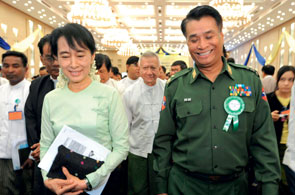
Myanmar opposition leader Aung San Suu Kyi (left) talks with Border Affairs Minister Major General Thein Htay, as they attend the Economic Development Workshop in Naypyidaw |
In her first comments on Friday’s discussions with President Thein Sein, a former general, the Nobel laureate indicated that the one hour meeting in the capital Naypyidaw had gone well.
“I am glad to see him and I am encouraged,” she told reporters.
The talks, a rare encounter between Suu Kyi and one of the members of the junta who kept her locked up for much of the past two decades, are the latest example of contacts between the government and its most renowned critic.
It was the opposition figurehead’s first visit to the remote purpose-built capital, at the invitation of the regime, which came to power in March after a widely condemned election marred by the absence of Suu Kyi and her party.
A Myanmar official, who asked not to be named, said the meeting was “quite good and quite open” without giving details of the nature of discussions, which were held behind closed doors.
In a short article on the talks, government mouthpiece the New Light of Myanmar said both sides sought “potential common grounds to cooperate in the interests of the nation and the people, putting aside different views”.
The newspaper published a picture of Suu Kyi with Thein Sein at the presidential residence.
Suu Kyi remained in Naypyidaw overnight and attended a forum on the impoverished nation’s economy on Saturday morning.
The 66-year-old appeared relaxed and cheerful and spoke with senior government officials and ministers.
Suu Kyi was told in June to stay out of politics and warned that a political tour could spark chaos and riots.
But Myanmar’s government led by Thein Sein, a former junta prime minister, has since appeared to want to soften its image.
“It seems to me that the government wants to demonstrate that they are not the same people from the past, that they want to do something good for the country,” said Myanmar expert Aung Naing Oo.
He added that while it was still unclear whether government overtures were a genuine attempt at warmer ties or a way of engineering better international relations, they are “extremely important” for reconciliation in the country.
In recent weeks, Suu Kyi has held two rounds of talks with labour minister Aung Kyi in Yangon and has written an open letter offering to aid ceasefire talks between the military and ethnic rebels.
Last Sunday the daughter of Myanmar’s liberation hero General Aung San travelled unhindered on her first overtly political trip outside her home city since being released from detention, addressing thousands of supporters.
In a further sign the new government is seeking to improve its image, UN rights envoy Tomas Ojea Quintana is also being permitted to visit Myanmar from today for the first time in more than a year.
Quintana has been a vocal critic of Myanmar’s rulers, enraging the junta after his last trip by suggesting that human rights violations in the country may amount to crimes against humanity and could warrant a UN inquiry.
The international community has called for a number of reforms in Myanmar including the release of around 2,000 political prisoners.
Myanmar’s elections last November followed nearly half a century of military rule.
Suu Kyi’s National League for Democracy (NLD) boycotted the poll because of rules seemingly designed to exclude the democracy icon, and was stripped of its status as a political party as a result.
The NLD won a 1990 vote by a landslide but was never allowed by the junta to take power. AFP