


 |
|
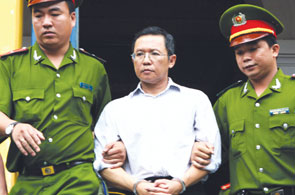
French-Vietnamese blogger and lecturer Pham Minh Hoang is led out from the courtroom at the Ho Chi Minh City People’s Court House after he was jailed for three years for attempted subversion |
France said it deeply regretted the verdict and called for it to be reconsidered.
Pham Minh Hoang, 56, who holds dual nationality, had undermined national security, chief judge Vu Phi Long said at the close of a trial that lasted half a day.
Long said Hoang wrote 33 articles under the pen name Phan Kien Quoc, “blackening the image of the country” and aiming to overthrow the government.
Dozens of peaceful political critics have been sentenced to long prison terms since Vietnam launched a crackdown on free expression in late 2009, according to Amnesty International.
Hoang expressed regret and asked for leniency, saying he did not know he was violating the law.
“My writings were not aimed at overthrowing anyone,” he testified. “I only pointed out the negative things in society, and I think the country needs to be more democratic.”
His lawyer, Tran Vu Hai, said Hoang was not well known on the Internet and was only exercising his right to free speech, drawing on his experience in France “where there is a civilised education environment”.
French authorities repeatedly sent messages to Vietnamese officials in order that a “favourable outcome” be found for Hoang, said Christine Fages, deputy spokeswoman of the foreign ministry.
“We wish that this verdict be reconsidered so that Pham Minh Hoang can get his liberty as soon as possible,” said Fages, reiterating France’s commitment to freedom of expression, including on the Internet.
Hoang admitted that he joined US-based opposition group Viet Tan in 1998 but said he was not acting under their instruction.
Viet Tan, the Vietnam Reform Party, describes itself as non-violent and pro-democracy but Vietnam labels it “terrorist”.
Reacting to the verdict, Viet Tan said Hoang had engaged in peaceful activities that aimed to improve Vietnam.
“Rather than uniting the country to deal with the grave threats from China, the Hanoi authorities remain focused on suppressing domestic dissent,” it said.
The year Hoang has already spent in custody will count towards his jail sentence, which will be followed by a further three years of house arrest, the judge ruled.
He could have received up to 15 years in prison.
Plainclothes and uniformed security officers were seen on the streets outside the French colonial-era courthouse where the trial took place.
One policeman tried to stop a photographer from taking pictures of officers, who were armed with clubs.
The trial came two weeks after Prime Minister Nguyen Tan Dung was named to a second term after consolidating his power, which activists fear heralds a tougher climate for dissidents in the one-party communist state.
Hoang went to France in 1973 but returned home after 27 years to work as a mathematics lecturer at the Polytechnic University of Ho Chi Minh City, his wife has said.
Last week an appeal court in Vietnam upheld a seven-year jail term against French-trained legal expert Cu Huy Ha Vu, who had twice tried to sue the prime minister.
Both the United States and European Union expressed concern over the ruling, as they had days earlier when Vietnam returned to prison another prominent dissident, Nguyen Van Ly, a Catholic priest with a brain tumour.
Vietnam’s foreign ministry insisted on Tuesday that there are “no so-called ‘prisoners of conscience’” in Vietnam. AFP