


 |
|
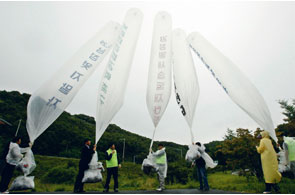
Former North Korean defectors and conservative protesters prepare to release balloons carrying anti-North Korea leaflets towards the north at a field near the demilitarised zone separating the two Koreas in Paju, north of Seoul, yesterday on the occasion of the 61st anniversary of the outbreak of the 1950-53 Korean War. The activists released about 100,000 anti-Pyongyang leaflets |
ould take place.
“While we remain open to direct engagement with North Korea, we remain firm in our resolve and our shared position that Pyongyang must improve its relations with the Republic of (South) Korea,” Clinton said after a meeting with South Korean Foreign Minister Kim Sung-hwan.
Kim said both sides agreed that Pyongyang and Seoul should first hold bilateral talks before any move to resume so-called six-party talks, which also bring in the US, China, Japan and Russia.
Those talks, dormant for more than two years, aim to offer Pyongyang aid and diplomatic recognition in return for scrapping its nuclear program, which Washington, Seoul and Tokyo regard as a serious threat to the region.
“The six party talks, once resumed, should yield substantial progress in denuclearization. To this end, we reaffirmed that North Korea must demonstrate its sincerity toward denuclearization through concrete actions,” Kim said.
The US and South Korean statements appeared to put to rest suggestions that China - North Korea’s main international backer - could persuade Washington and Seoul to rejoin nuclear talks soon despite their suspicions of Pyongyang’s motives.
The talks have been on hold since 2009, when Pyongyang walked out of the process after a new round of UN sanctions.
North Korea agreed in 2005 to abandon its nuclear programs in return for aid, but that deal collapsed and the North subsequently conducted two nuclear tests in 2006 and 2009. It is also blamed for two deadly attacks on the South last year.
Clinton said the US had made no decision on resuming food aid to North Korea, which a UN report said earlier this year was lurching into serious crisis with more than 6mn people in need of help.
Critics of aid say the North has siphoned off the food in the past to feed its million-strong army, and South Korea says the North’s food stocks are at the same levels as last year.
Officials in Seoul also accuse North Korea of trying to hoard food ahead of a third nuclear test, which would likely provoke a further tightening of international sanctions.
The US suspended food supplies to the North in 2008 over a monitoring dispute, and has said it will only resume assistance with Seoul’s agreement.
While a US assessment team visited North Korea last month to gauge the situation, Clinton said there were still concerns about how Pyongyang might handle any influx of aid.
“Of course the US is deeply concerned about the well-being of the North Korean people, but we have made no decision about providing food aid to North Korea at this time,” Clinton said.
She said any future food assistance would be weighed on legitimate humanitarian needs, competing needs elsewhere in the world, and “our ability to ensure and monitor that whatever food is provided actually reaches the people who are in need”. Reuters