


 |
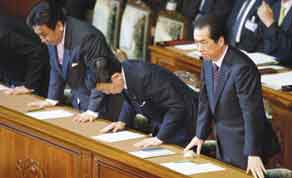
| Prime Minister Naoto Kan (right) and members of his cabinet bows following the results of a no-confidence motion against him in the Japanese Diet in Tokyo yesterday |
The promise to hand over power to a younger generation mollified internal party rebels who had threatened to bring down Kan, the country’s fifth premier in as many years, days before his first anniversary in the job.
The motion brought by the opposition conservative Liberal Democratic Party (LDP) and its allies was defeated by a 293-152 margin after most lawmakers of the centre-left ruling party fell into line behind Kan.
Kan, 64, in a last-minute appeal to his fractured Democratic Party of Japan (DPJ), urged its lawmakers to stick together until he makes significant progress in rebuilding from Japan’s worst post-war emergency.
“Once my handling of the earthquake disaster is settled to some extent and I have fulfilled my role to some extent, I would like younger generations to take over my various responsibilities,” said the prime minister.
Kan, a self-styled “son-of-a-salaryman”, or man of the people, offered no precise milestone, leaving his departure date open to interpretation.
The government has promised that most of the 100,000 people still living in shelters since the quake disaster will be in temporary housing by mid-summer, but the wider clean-up and reconstruction is expected to take years.
The operator of the tsunami-hit Fukushima nuclear power plant has said it hopes to bring its six reactors to “cold shutdown” between October and January, but decommissioning and decontaminating the site will also take far longer.
The LDP — which was ousted in a landslide 2009 election after more than half a century of almost unbroken rule — had submitted the no-confidence motion late Wednesday with two small parties.
LDP leaders have accused Kan of bungling the response to the disaster that left more than 23,000 dead and missing and sparked the world’s worst nuclear crisis since Chernobyl a quarter-century ago.
Kan’s arch-rival within the DPJ, scandal-tainted veteran powerbroker Ichiro Ozawa, threatened to vote against Kan but in the end abstained, and only two DPJ lawmakers ended up voting against Kan.
Some 30 other lawmakers, including Social Democrats and Communists, also abstained from the vote in the lower house of the Diet.
The DPJ party leadership had battled to enforce party discipline by threatening to expel rebels and, if Kan lost, to call a snap election, which would have left expelled members struggling to retain their seats.