


Reuters/Tokyo
The neediest victims of Japan’s devastating earthquake and tsunami have yet to receive much of the record $2.2bn aid two months later, mainly because the authorities have yet to identify them, the country’s Red Cross said yesterday.

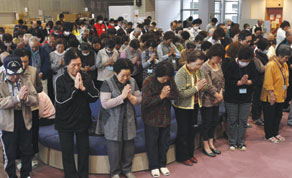
Evacuees observe a moment of silence for those who were killed by the March 11 earthquake and tsunami, at an evacuation shelter in Soma, Fukushima prefecture, about 50km from the crippled Daiichi nuclear power plant yesterday, on the two-month anniversary of the tragedy
The March 11 quake and tsunami and nuclear crisis that followed at the Fukushima Daiichi plant left nearly 25,000 dead or missing, sent more than 117,000 people away from their homes and destroyed infrastructure in the north of Japan.
The Japanese Red Cross Society has so far collected 174bn yen ($2.2bn) in relief money, the most it has ever been given for any relief campaign.
The charity distributed about 65bn yen in April to regional governments in the disaster-hit area, but says that this fund has yet to reach those most in need.
“The biggest problem is that those who should be receiving the money cannot be identified, as more than 10,000 people are still missing, resident registrations are gone and the administrative functions at the periphery are not working,” said Tadateru Konoe, president of the Japanese Red Cross.
“The money has reached the prefectural level, but I recently saw a report that much of the actual distribution (to quake victims) has yet to take place,” he told a news conference.
All of the organisation’s relief money is meant to be handed to victims, in cash, and the group has been criticised for the delay in distribution. In 1995, when a huge quake struck Kobe in western Japan, the initial round of cash handouts was made within about two weeks of the disaster.
A panel of officials and experts decided last month on the parameters of the initial round of aid distribution, such as giving 350,000 yen to families who lost a member and the same amount to families whose homes were destroyed.
The Japanese Red Cross still has more than 100bn yen in relief money, and Konoe, also president of the International Federation of Red Cross and Red Crescent Societies, said there was no clear plan yet on how to distribute this. He said the money could also be given to businesses as well as individuals.
Japan has started to clean up and rebuild the damaged region but the job is daunting and the area is still a ruin.
A no-entry zone is still in place 20 km around the stricken Fukushima Daiichi plant, though residents of one town were allowed to return on Tuesday for two hours for the first time since the disaster.
In a poll by Yomiuri newspaper that surveyed mayors and leaders of 41 towns and cities in the disaster-struck areas, most said they felt there was no clear vision for rebuilding their lives.
Seventeen mayors said they did not have a clear idea of when the clearing of rubble would finish in their areas, while nine said they did not know when the electricity and water systems would function properly again.
Konoe said that many medical services in disaster-struck areas remained shut and that stress-related illnesses were among the biggest health risks to the displaced.
The total cost of the damage has been estimated at $300bn, making it the world’s most costly natural disaster.