


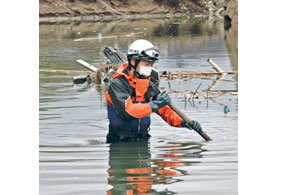
The Japanese government said yesterday that it was considering banning entry into the 20-kilometre exclusion zone around a damaged nuclear power plant that is leaking radiation.

A firefighter searches for missing people following the March 11 earthquake and tsunami in Ishinomaki, Miyagi Prefecture, northern Japan yesterday
“We are talking with local officials about setting up legally binding ‘caution areas,’” Chief Cabinet Secretary Yukio Edano said.
The government has directed residents within 20 kilometres of the Fukushima Daiichi Nuclear Power Station to evacuate, but there has been no formal order to vacate the area.
Some have returned to their homes to pick up belongings, despite fears of radiation leaking from the plant after it was crippled by a magnitude-9 earthquake and tsunami on March 11, Kyodo said.
Those living between 20 and 30 kilometres away have been advised to stay indoors as much as possible.
Prime Minister Naoto Kan was expected to announce the stricter restrictions today during a visit to Fukushima prefecture to meet the evacuees, Kyodo News agency reported.
The government also decided to ban shipments of sand lance, a type of fish, which landed in Fukushima, after a sample caught Monday off Iwaki City was found to have 14,400 becquerels per kilogram of radioactive caesium, well over the legal limit of 500 becquerels per kilogram.
High levels of radiation have been found in water in and around the plant, after emergency workers poured water over the damaged reactors for weeks in an effort to keep the radioactive fuel rods from overheating. The French nuclear energy firm Areva SA has said it plans to install a facility to decontaminate radioactive water at the plant 250 kilometres north-east of Tokyo, chief executive Anne Lauvergeon said.
Areva said the company would try to get the decontamination system up and running by the end of May as requested by plant operator Tokyo Electric Power Co, the Jiji Press agency reported.
The system would be capable of decontaminating 50 tonnes of water per hour, Lauvergeon said Tuesday, adding that the treatment would reduce the radiation levels of the water to one-1,000th to one-10,000th, Jiji said.
The company said it hoped to use the decontaminated water to cool the plant’s overheating reactors, Jiji said.
Takashi Shinohara, senior vice minister of agriculture, forestry and fisheries, was to travel to Ukraine today to learn from the decontamination experience after the 1986 nuclear disaster at Chernobyl power plant, especially concerning irradiated soil.
Shinohara also planned to attend the Kiev Summit on Safe and Innovative Use of Nuclear Energy to mark the 25th anniversary of the Chernobyl disaster, the ministry said.
The International Atomic Energy Agency said it would dispatch a team of experts to Japan to investigate the cause of the incident and measures taken in the aftermath, although no date was yet fixed, Japanese public broadcaster NHK reported.
The agency’s deputy director general, Denis Flory, said the radiation released by the plant was expected to decrease substantially if efforts to bring it under control go as planned.
The company said this week that it hoped to restore stable cooling to the plant’s six reactors in three months and be able to get the whole plant under control within nine months.
The operator began moving the contaminated water into an on-site storage facility Tuesday. It expects to remove a total of 25,000 tons of the contaminated water out of the basement of the turbine building of reactor 2 and an adjacent trench,
officials said. DPA