


AFP/Tokyo
 |
|
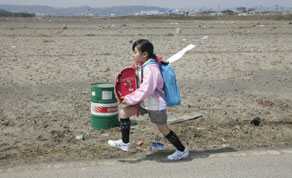
Ayano Soga, a second grader schoolgirl at Shimo-Masuda Elementary School, walks through a tsunami-devastated area on the way back to her home with a backpack given by Unicef after the start of the new school year in Natori, south of Sendai, Miyagi Prefecture, northern Japan |
Appearing in parliament for the first time since a huge earthquake and tsunami crippled its Fukushima Daiichi plant, the head of the Tokyo Electric Power Company (TEPCO) faced a barrage of criticism from politicians.
“What do you plan to do to take ultimate responsibility (for the crisis)?” one opposition lawmaker asked TEPCO President Masataka Shimizu, 66, who has rarely been seen in public since the tsunami swamped the plant on Japan’s northeast coast.
“These documents contain very strict safety rules,” said Shuichi Kato of the opposition New Komeito party, brandishing a copy of the company’s own safety regulations.
“This says the president regards nuclear safety as the top priority. With this in mind, let me ask how you feel now?”
Shimizu’s appearance came a day after TEPCO said it would be nine months before the plant’s six reactors could be put into “cold shutdown”—a stable condition in which temperatures drop and radiation leaks fall dramatically.
Tens of thousands of people living near the plant have had to evacuate their homes since the March 11 disaster, which sparked a series of explosions that have caused radiation to leak into the air, soil and sea.
Shimizu delivered a brief apology over the crisis on March 13, but then fell ill and was not heard of again until nearly a month later when he visited Fukushima, meeting local officials but not residents made homeless by the radiation spewing from the plant.
“If you did your best, then why did it explode?” asked Communist Party lawmaker Mikishi Daimon, accusing the company of failing to prepare for such an event and pressing Shimizu to “admit TEPCO caused the accident”.
Shimizu, who has repeatedly apologised over the crisis, defended TEPCO’s performance, saying the devastating tsunami was “beyond our expectations”.
“As the person who assumes final responsibility for coordinating the safety strategy for the nuclear power plant, I acknowledge the seriousness of this incident,” he said. “I cannot find words enough to express my apology.”
Shares in TEPCO are down almost 80% since the quake and tsunami on expectations it will face huge compensation claims totalling around 10tn yen ($120bn) according to some estimates.
The government on Friday ordered TEPCO to offer initial payouts to tens of thousands of people made homeless by the ongoing crisis, with 1mn yen ($12,000) going to each family living around the stricken plant.
The official death toll from the quake and tsunami stands at 13,895, with 13,864 still listed as missing, Kyodo News agency reported, quoting the National Police Agency.
The TEPCO president appeared yesterday as a witness at the hearing of the parliament’s cross-party budget committee, which also grilled Prime Minister Naoto Kan over his government’s handling of the nuclear crisis.
Support for the government has risen following the March 11 disaster, but a majority of voters criticised its response to the atomic crisis in a poll commissioned by the Nikkei business daily and published on Monday.
The poll results came as Toyota said it was resuming operations at all its domestic plants that had been halted since March 11, though a shortage of parts means production will be restricted to 50%.
Toyota also said it had started testing radiation levels of its export vehicles, parts for overseas assembly and service parts and had found no abnormalities.
On Sunday, TEPCO said it aimed to cool reactors and start reducing radiation from the facility within three months and expected to achieve cold shutdown within three to six months of that stage being completed.
It said the initial focus would be on preventing new hydrogen explosions in reactors by injecting nitrogen, and on avoiding further releases of radioactive water.
An unknown quantity of highly radioactive liquid has leaked into the Pacific Ocean from the plant, devastating the local fishing industry.
TEPCO has also dumped more than 10,000 tonnes of mildly radioactive water into the sea to free up urgently needed storage space for highly toxic liquid.
Two robots used to investigate a damaged nuclear plant in north-eastern Japan found high levels of radiation inside its reactor buildings, the government said yesterday.
The levels inside the buildings of reactors 1 and 3 at the six-reactor Fukushima Daiichi Nuclear Power Station ranged from 10 to 57 millisieverts per hour as of Sunday, according to data obtained by the US-made, remote-controlled robots.
The levels would make it hard for workers to engage in the restoration of key cooling functions at the earthquake- and tsunami-damaged plant for prolonged periods, the Kyodo News agency reported, citing the government’s Nuclear and Industrial Safety Agency.
Exposure to 250 millisieverts per year is the permissible level for workers dealing with the ongoing crisis while the Tokyo Electric Power Co (TEPCO), which runs the plant, said that usually the radiation level inside the reactor buildings is 0.01 millisievert per hour, Kyodo reported.
TEPCO used the PackBots of iRobot Corp of the United States to check radiation, temperature, humidity and oxygen density, the Jiji Press agency said.
High levels of radiation have prevented workers from entering the buildings of reactors 1 to 3 since March 11.
The operator has been injecting massive amounts of water into the reactors and their spent-fuel pools to cool them down, but pools of radiation-contaminated water have been found around the site, further hindering work to restore the cooling systems.
TEPCO said the amount of polluted water in the turbine buildings of reactors 1 to 3 and nearby areas totalled an estimated 67,500 tonnes, Kyodo reported.