


 |
|
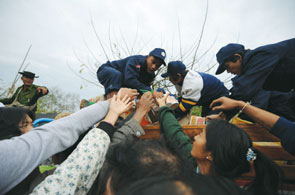
Survivors of the earthquake extend their hands to receive packets of relief food, in Tarlay, northeastern Myanmar yesterday. Rescue teams struggled to reach those affected by a |
Officials say 75 people were killed by the 6.8 magnitude quake that hit near the borders with Thailand and Laos late on Thursday, reducing homes and government buildings to rubble and affecting thousands of people.
“As we learn more it appears that the casualty figures will continue to increase,” an aid worker in the country said, asking not to be named.
Tachileik town and nearby Tarlay and Mong Lin in Myanmar’s Shan state appeared to have been most severely affected by the quake, which was felt as far away as the Vietnamese capital Hanoi.
“We don’t know how many people were affected yet. We are still trying to get the figures,” a Myanmar official said yesterday.
“Transportation is difficult. We still haven’t reached some areas, we still don’t know what happened to them and we don’t know how many people are living in these mountainous areas,” he added, declining to be named.
An unnamed Red Cross worker in Tachileik told exile news group the Irrawaddy that at least 150 people had been killed, but the official said there was no confirmed increase from Friday’s toll of 74. One woman was also killed in Thailand.
The charity World Vision believes around 15,000 people may have been affected in the worst-hit areas.
“One of the things that’s really emerging is water as a critical need. That’s the immediate challenge in addition to temporary shelter,” said Chris Herink, the charity’s Myanmar country director in Yangon.
The group, in partnership with the health ministry, is sending tens of thousands of water purification tablets along with first aid kits and emergency shelters and supplies.
In Tarlay, where buildings were flattened and roads riven with huge cracks, work began yesterday to fix a bridge that was destroyed in the disaster, while families started to hold funerals for their loved ones who were killed.
The affected region was already difficult to reach before the quake, while access to the area by foreigners is restricted and the military-dominated government tends to keep a tight grip on information.
The ruling junta was widely criticised for refusing foreign assistance for weeks after cyclone Nargis wrought devastation across the Irrawaddy Delta in May 2008, leaving more than 138,000 people either killed or missing.
But Herink has said his organisation, which is working in the affected areas with the Myanmar Red Cross and Unicef, had found the government had been proactively co-operating.
He said a report by authorities assessed the estimated financial damage in Tarlay alone at US$3.5mn.
Yesterday’s state New Light of Myanmar newspaper detailed the official relief effort on its front page after various ministers travelled to Tachileik from the capital Naypyidaw on Saturday. “They comforted earthquake-hit victims and presented cash assistance to them,” the English-language paper said.
But many have been getting their news from Thai radio rather than sources in Myanmar, and one Tachileik resident, posting anonymously on Saturday on an Internet forum, lamented the lack of “concrete assistance from authorities”.
“The whole village is gone,” said another resident, Nan Myint, tearfully explaining that she had lost her father, nephew and sister-in-law in the quake, which took place while she was in Yangon.
Thai premier Abhisit Vejjajiva called for a review of his country’s quake preparedness on a visit to the National Disaster Warning Centre yesterday, after the tremor damaged buildings in the north and raised alarm across Thailand. AFP