


 |
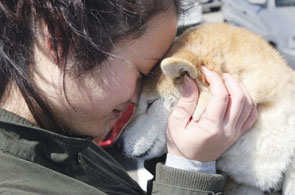
| 17year-old evacuee Shoko Igarashi hugs her dog that will have to be looked after by friends while she goes into a shelter in Koriyama in Fukushima prefecture, yesterday |
The first official estimate since the March 11 disaster covers damage to roads, homes, factories and infrastructure, and dwarfs losses from both the 1995 Kobe quake and Hurricane Katrina that swept through New Orleans in 2005, making it the world’s costliest natural disaster.
As concern grew over the risk to food safety of radiation from the damaged Fukushima power plant, 250km north of the Japanese capital, the US became the first nation to block some food imports from the disaster zone.
The plant, battered by a 9.0 magnitude earthquake and tsunami that has left 23,000 people dead or missing, has still not been brought under control, and workers were forced away from the complex when black smoke began rising from one of its six reactors.
Tokyo authorities said yesterday that water at a purification plant for the capital of 13mn people had 210 becquerels of radioactive iodine - more than twice the safety level for infants.
Tokyo Governor Shintaro Ishihara, however, said that level posed no immediate risk and water could still be used. “But, for infants under age one, I would like them to refrain from using tap water to dilute baby formula,” he added.
The US Food and Drug Administration said it was stopping imports of milk, vegetable and fruit from four prefectures in the vicinity of the stricken nuclear plant.
Hong Kong, a major importers of Japanese food, also banned produce and milk imports from the disaster zone. Japan’s Jiji news agency said Hong Kong authorities had found radioactivity levels in spinach and turnip samples up to 10 times over the safety limit.
South Korea may be next to ban Japanese food after the world’s worst atomic crisis since Chernobyl in 1986. France this week asked the European Commission to look into harmonising controls on radioactivity in imports from Japan.
Food made up just 0.6% of Japan’s total exports last year.
Authorities have said above-safety radiation levels had been discovered in 11 types of vegetables from the area, in addition to milk and water, and they have halted shipments of some food and told people there to stop eating leafy vegetables.
Chief cabinet secretary Yukio Edano, who has been the government’s public face during the disaster, urged the world not to overreact.
“We have measures in place that keep products with radiation above a certain level out of circulation. That means anything in circulation is safe. This is not necessarily well understood by other countries,” he told a news conference.
Edano also said an exclusion zone around the plant did not need to be expanded and he urged Tokyo residents not to hoard bottled water. But his plea fell on deaf ears with many shops quickly selling out of supplies.
“If this were temporary, I wouldn’t be so worried. If this is a long term, I think we have a lot to worry about,” said Riku Kato, father of a one-year-old baby.
Other Asian neighbours are inspecting imports for contamination and Taiwan advised boats to stop fishing in Japanese waters.
At the Fukushima plant, engineers battling to cool reactors to contain further contamination were evacuated when black smoke rose from the No 3 reactor, the plant’s operator, Tokyo Electric Power Co (TEPCO) , said. It did not know what caused the smoke.
A government official later told reporters the smoke was not a serious issue.
The Asian nation’s worst crisis since World War Two has sent shock waves through global financial markets.
The damage estimate of $300bn could go higher as it does not include losses in economic activity from planned power outages or the broader impact of the nuclear crisis. The 1995 Kobe quake cost $100bn while Hurricane Katrina caused $81bn in damage.
More than a quarter of a million people are living in shelters, while rescuers and sniffer dogs comb debris and mud looking for corpses and personal mementos.
Technicians have successfully attached power cables to all six reactors at the Fukushima plant and started a pump at one to cool overheating fuel rods.
As well as having its workers on the front line in highly dangerous circumstances, TEPCO is also facing accusations of a slow disaster response and questions over why it originally stored more uranium at the plant than it was designed to hold.
The International Atomic Energy Agency (IAEA), the Vienna-based UN watchdog, expressed concern about a lack of information from Japanese authorities. It cited missing data on temperatures of spent fuel pools at the facility’s reactors 1, 3 and 4.
“We continue to see radiation coming from the site ... and the question is where exactly is that coming from?” said a senior IAEA official, James Lyons.
Worsened by widespread ignorance of the technicalities of radiation, public concern is rising around the world and radioactive particles have been found as far away as Iceland.
Experts said tiny radioactive particles, measured by a network of monitoring stations as they spread eastwards from Japan across the Pacific, North America, the Atlantic and to Europe, were far too low to cause any harm to humans.
“It’s only a matter of days before it disperses in the entire northern hemisphere,” said Andrea Stahl, a senior scientist at the Norwegian Institute for Air Research.
The Japan disaster has dealt a blow to the nuclear power industry around the world. Italy became the latest nation to re-assess its programme, announcing a one-year moratorium on site selection and building of plants.
Crisis in the world’s third-biggest economy - and its key position in global supply chains, especially for the auto and technology sectors - has added to global market jitters, also affected by conflict in Libya and unrest in the Middle East.
Asian shares fell yesterday, with Tokyo’s Nikkei ending 1.65% down as investors took profits from a two-session bounce. Japanese stocks are about 8% below their close on the day the big earthquake struck.
Toyota said it would delay the launch in Japan of two additions to the Primus line-up, a wagon and a minivan, due to production disruptions.
The death toll from the disaster has risen to 9,199, but with 13,786 people still missing, it is certain to rise.
There are reports that dozens of survivors, mostly elderly, have died in hospitals and evacuation centres from a lack of proper treatment, or simply because of the cold.
The nuclear emergency following the earthquake and tsunami in Japan has led 25 embassies to temporarily shut their doors in Tokyo, Foreign Minister Takeaki Matsumoto said yesterday.
Matsumoto provided the figure in an appearance before the lower house foreign affairs committee. Germany, Switzerland and Finland headed the list.
As of Tuesday, “eight of them had transferred their functions outside Tokyo or Japan”, a foreign ministry spokesman said by e-mail.
“The rest have had their staff stay home. They have been changing its working arrangement day by day,” he said.
“At any rate, the Ministry of Foreign Affairs keeps in touch with the embassies temporarily transferred or embassy staff staying home, providing accurate information to the entire diplomatic corps.”
The foreign ministry’s press division said the following countries had closed their doors: Angola, Bahrain, Benin, Botswana, Burkina Faso, Croatia, Dominican Republic, Ecuador, Finland, Germany, Ghana, Guatemala, Kenya, Kosovo, Lesotho, Liberia, Libya, Malawi, Mauritania, Mozambique, Namibia, Nepal, Nigeria, Panama and Switzerland.
Switzerland has temporarily moved its embassy to Osaka, citing the “very uncertain” situation at the Fukushima nuclear plant.
The US State Department last week authorised the “voluntary departure” of embassy family members in Tokyo, including relocation to other areas within Japan.
The earthquake and tsunami that devastated northeast Japan this month have left some parts of the region without cigarettes, Japan Tobacco Inc said, a blow to smokers in a country where the habit is still popular.
A spokesman said that some of its distribution centres in the region had been hit by the disasters, and some brands were out of stock in some regions.
Brands made by Japan Tobacco, the world’s third-largest tobacco manufacturer, include Benson & Hedges, Camel and Winston.
The company could not say what impact the disasters would have on sales, the spokesman said, adding that it was unlikely to have a big effect on its sales forecasts for the year.
Smoking is still popular in Japan and is allowed in bars, most restaurants and even some offices.
In an effort to crack down on the habit, government has banned it from Tokyo’s streets and forced manufacturers to display tougher health warnings on cigarette packs.
Until recently many packs carried tame warnings such as “Be careful not to smoke too much”.