


 |
|
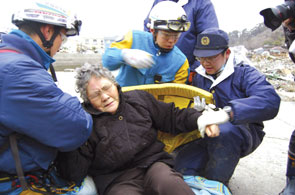
Emergency workers help 80-year-old Sumi Abe (centre) after being rescued from under the rubble in Ishinomaki City, Miyagi Prefecture, northern Japan yesterday. Sumi and her 16-year-old grandson Jin Abe were found alive under the rubble, nine days after the earthquake and tsunami |
Three hundred engineers have been struggling inside the danger zone to salvage the six-reactor Fukushima plant in the world’s worst nuclear crisis since Chernobyl 25 years ago.
“I think the situation is improving step by step,” Deputy Chief Cabinet Secretary Tetsuro Fukuyama told a news conference.
In one remarkable story of survival, an 80-year-old woman and 16-year-old youth were found alive under the rubble in the devastated city of Ishinomaki, nine days after the killer earthquake and tsunami, NHK public TV said, quoting police.
At the nuclear plant, workers braving high radiation levels in suits sealed in duct tape managed to connect power to the No 2 reactor, crucial to their attempts to cool it down and limit the leak of deadly radiation.
Officials at plant operator Tokyo Electric Power Company (Tepco) said the workers aimed to restore the control room function, lights and the cooling at the No 1 reactor, which is connected to the No 2 reactor by cable.
But rising cases of contaminated vegetables, dust and water have raised new fears. The government has prohibited the sale of raw milk from Fukushima prefecture and spinach from another nearby area. It is considering further restrictions on food.
Tokyo, just 240 km south of the crippled plant and where the government said it had found traces of radioactive iodine, was subdued yesterday but there was no sense of panic.
“There’s no way I can check if those radioactive particles are in my tap water or the food I eat, so there isn’t much I can really do about it,” said Setsuko Kuroi, an 87-year-old woman shopping in a supermarket in the capital with a white gauze mask over her face.
“I don’t plan big changes to my diet. And I only drink bottled water.”
Police said they believed more than 15,000 people had been killed in Miyagi prefecture, one of four in Japan’s northeast that took the brunt of the tsunami damage. In total, more than 20,000 are dead or missing, police said.
The unprecedented crisis will cost the world’s third largest economy up to quarter of atn dollars and require Japan’s biggest reconstruction push since post-World War Two.
It has also set back nuclear power plans the world over.
Economics Minister Kaoru Yosano put the economic damage at above 20tn yen ($248bn), which was his estimate of the total economic impact of the 1995 earthquake in Kobe.
Government spending was likely to exceed the 3.3tn yen Tokyo spent after Kobe, which up to now has been considered the world’s costliest natural disaster.
Encouragingly for Japanese transfixed on work at the Fukushima complex, the most critical reactor- No 3, which contains highly toxic plutonium -- stabilised after fire trucks doused it for hours with hundreds of tonnes of water.
Plant operator Tepco said it may take days to restore power at the No 3 and No 4 reactors. Power is needed to reactivate water pumps to cool fuel rods in the reactors. If the pumps cannot be restarted, drastic measures may be required such as burying the plant in sand and concrete, as happened at Chernobyl in 1986, though experts warn that could take many months.
The Japan crisis is already rated as bad as America’s Three Mile Island accident in 1979.
Although public fear of radiation runs deep, and anxiety has spread as far as the Pacific-facing side of the US, Japanese officials say levels so far are not alarming.
Some airports in Asia have been checking passengers arriving from Japan for signs of radiation, including Jakarta airport where officials were using Geiger counters on all those coming on flights from Japan.
Physicians for Social Responsibility, a US non-profit advocacy group, called for a halt to new nuclear reactors in the US.
“There is no safe level of radiation exposure,” said Jeff Patterson, a former president of the group.
The quake and ensuing 10-metre high tsunami devastated Japan’s north east coastal region, wiping towns off the map and making more than 360,000 people homeless in a test for the Asian nation’s reputation for resilience and social cohesion.
Food, water, medicine and fuel are short in some parts, and low temperatures during Japan’s winter are not helping.
The traumatic hunt for bodies and missing people continues.
About 257,000 households in the north still have no electricity and at least 1 mn lack running water.
Prime Minister Naoto Kan was to visit the affected region today, Kyodo news agency said. Reuters