


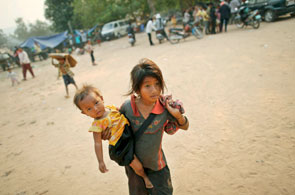
Displaced Cambodians carry their belongings to a pagoda where they found shelter after fleeing from the area near the 11th-century Preah Vihear temple at the border between Thailand and Cambodia yesterday
Thai and Cambodian troops clashed for a fourth straight day yesterday over a disputed border area surrounding a 900-year-old mountaintop temple, deepening political uncertainty in Bangkok and prompting Cambodia to urge UN intervention.

Several hours of shelling and machine gun fire subsided at around 11am (0400 GMT), creating an uneasy peace in the 4.6sqkm contested area around the Preah Vihear temple claimed by both Southeast Asian neighbours.
Cambodia’s government said yesterday fighting had killed five people and wounded 45 others on its side of the border. It did not specify whether the casualties were troops or civilians.
Both sides blame the other for sparking clashes that have killed at least two Thais and eight Cambodians since Friday and unleashed nationalist passions in Bangkok, energising “yellowshirt” protesters demanding Thailand’s government step down.
Reasons behind the fighting remain murky. Some analysts reckon hawkish Thai generals and nationalist allies may be trying to topple Thailand’s government or even create a pretext to stage another coup and cancel elections expected this year.
Others say it may be a simple breakdown in communication channels at a time of strained relations over Cambodia’s flying of a national flag in the disputed area and laying of a stone tablet inscribed with “This is Cambodia”.
In Phum Saron, an evacuated village in Thailand’s Si Sa Ket province where Cambodian artillery struck several homes and a school on Sunday, Thai soldiers guarded buildings and said it was unclear if more fighting loomed.
On the Cambodian side of the frontier, pigs and chickens roamed deserted villages. Schools and temples were turned into makeshift refugee centres. Naked children played as people collected firewood or queued for handouts of rice and water.
Several trucks each carrying at least 100 Cambodian infantry soldiers were seen racing towards the conflict zone.
Cambodian Prime Minister Hun Sen called on the UN Security Council to convene an urgent meeting, accusing Thailand of “repeated acts of aggression” that have killed Cambodians and caused a wing of the temple to collapse.
In a speech in the Cambodian capital Phnom Penh, Hun Sen directly addressed his Thai counterpart.
“We will go to the UN Security Council whether you like it or not,” he said during a university graduation ceremony, calling on the UN to deploy peacekeeping troops to the area. “The armed clash is threatening regional security.”
Thai Prime Minister Abhisit Vejjajiva wrote to the Security Council, saying Cambodia was trying to internationalise a bilateral issue, accusing its troops of launching attacks that were “pre-mediated and well-planned in advance”.
Thai troops “had no choice but to exercise the inherent right of self defence”, Abhisit said.
UN Secretary-General Ban Ki-moon said in a statement he was “deeply concerned” and urged both sides to cease fire and find a “lasting solution” to the dispute, echoing a similar statement from Washington over the weekend.
The Association of South East Asian Nations (Asean) dispatched Indonesian Foreign Minister Marty Natalegawa to Cambodia on Monday in a bid to defuse the crisis. He was scheduled to meet with Thai government officials in Bangkok today.
Natalegawa called for dialogue and for both sides to honour a cease-fire agreed on Friday to protect Asean’s integrity ahead of the formation of its European Union-style community.
“On the eve of an Asean community in 2015, guns must be silent in Southeast Asia,” he told reporters in Phnom Penh.
The dispute threatens to worsen hostility between Thai political factions ahead of the expected election this year.
Thailand’s police chief said he would seek cabinet approval to impose the Internal Security Act to enable security forces to stop protesters from occupying government buildings in Bangkok in a planned demonstration on Friday.
The “yellow shirts”, whose crippling rallies helped to bring Abhisit to power, have turned against him in recent weeks, calling for him to take a tougher line against Cambodia.