


 |
|
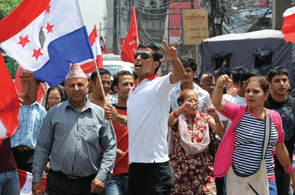
Nepalese activists shout slogans during a protest demanding the resignation of Prime Minister Baburam Bhattarai in Kathmandu yesterday |
Thousands of members of the public and party supporters turned up as the opposition called the government’s decision unconstitutional, and said they would campaign to remove Prime Minister Baburam
Bhattarai from power.
The term of the constituent assembly expired on May 27, as the parties failed to write a new constitution. They were locked in dispute over what form federalism should take in the multi-ethnic Himalayan nation.
Caretaker Prime Minister Baburam Bhattarai has announced fresh elections for November 22, but other parties have condemned that decision as “unilateral.”
The opposition wants the government to step down and make way for a broad-coalition government, which will conduct the election.
The two-year term of the constituent assembly had been extended four times since 2008, two years after the end of a decade-long civil war with Maoist rebels.
Leaders of National Democratic Campaign, an alliance of 22 political parties including Nepali Congress and CPN-UML, while addressing the rally held the Maoist leaders responsible for dissolving the constituent assembly, which they said, was the result of six-decade-long struggle of the Nepalese people to write their constitution.
They accused Bhattarai’s Maoist-led government of declaring election for another constituent assembly in an unconstitutional manner, with the intention to capture power.
Nepali Congress (NC) president Sushil Koirala and vice president Ramchandra Poudyal were other prominent leaders in the public meeting which was attended by tens of thousands of people.
The Maoists entered into the game of power capture through unconstitutional way, Poudyal said.
“The Maoists want to establish totalitarian rule and they were always opposed to inclusive democracy, pluralism and parliamentary system,” he said.
Five former prime ministers and top leaders of various political parties came down heavily on Bhattarai, asking him to quit power and to pave way for forming a national consensus government and help in resolving the current political stalemate.
Former prime ministers Sher Bahadur Deuba from Nepali Congress, Madhav Kumar Nepal and Jhala Nath Khanal from CPN-UML, Surya Bahadur Thapa from Rastriya Janashakti Party and Lokendra Bahadur Chanda from Rastriya Prajatantra Party, alleged that the real intention of the Maoists was to capture power and not to frame the constitution by May 27 deadline.
“The Maoists’ unconstitutional way of announcing election was aimed at capturing power and impose totalitarian rule by rigging the election by using their militant cadres, weapons and government machinery to garner two third majority, as claimed by Prachanda, which we would never allow,” Rastriya Prajatantra Party president Pashupati Shumsher Rana said.
NC general secretary Prakash Man Singh said that they will not participate in the election announced by Prime Minister Bhattarai “through unconstitutional way as they boycotted the local level elections conducted under the direct rule of then king Gyanendra in 2005.”
Devendra Mishra, general secretary of Sadbhawana Party-Anandidevi, said: “The few Madhesi parties who are currently with the Maoists’ ruling alliance will soon come with the democratic campaign of the opposition, as Madhesis can never be communists.”
He warned the Maoists not to attack democracy by putting guns on the shoulders of the Madhesis.
At the meeting, NC leader Sher Bahadur Deuba floated the idea of reinstating the 601-member Constituent Assembly for a certain time and resolving the remaining contentious issues to draft the constitution through consensus.
“At the time when the Maoists had dissolved the Constituent Assembly most of the contentious issues were resolved except the number of federal states and their names.
“The prime minister should step down for paving way to resolve the political crisis as he failed to deliver constitution within stipulated time frame,” Deuba said.
“The Maoists were trying to make a communist model of constitution by capturing power, not a democratic one,” said UML leader Madhav Kumar Nepal.
Maoists plan to hold fresh election by dissolving the Constituent Assembly was against the political consensus and undemocratic.
“The Maoists wanted to create a constitutional crisis to capture power”, said senior UML leader
K P Oli.
He asked the Maoists to come to an understanding with other political parties to resolve the current stalemate. Agencies