


 |
|
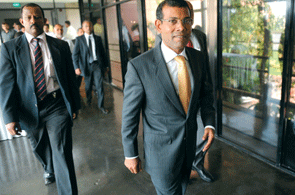
Former Maldives president Mohamed Nasheed, centre, walks outside a press conference in the Sri Lankan capital Colombo yesterday |
Nasheed, who met Sri Lankan leaders and Colombo-based diplomats in a bid to drum up support for his pro-democracy campaign, said he was ready to face a plebiscite on the legitimacy of his successor.
“The referendum question can be framed to determine the legitimacy of the (new) government,” Nasheed told reporters at the end of his overnight visit to Sri Lanka, his first travel abroad after he was replaced on
February 7.
Nasheed also expressed his confidence that there will be “pin drop silence” in Maldives as soon as the government announces a date for early
elections.
He condemned the recent attacks in capital Male against
security forces.
The former president, however, said his Maldivian Democratic Party (MDP) would not accept any solution other than early elections.
“Our party will have a primary in the event of an early election. I’ll personally seek the party ticket,” he said.
Nasheed has insisted that he was forced to step down after some 300 soldiers, backed by Salafist Islamic radicals and local businessmen, staged a mutiny that capped three weeks of anti-government protests.
He assured the international community that MDP is open for discussion. He also expressed shock at “how fast the US and India recognised the new regime.”
The former president accused current police chief Abdulla Riyaz and Defence Minister Mohamed Nazim of leading the coup. He, however, said the media’s use of “gun point” was a journalistic expression to describe the events that led to his resignation.
“I couldn’t say it was a coup when I was giving my resignation speech because the perpetrators of the coup were right next to me,” he said.
Nasheed defended his decision to detain the country’s chief criminal judge Abdulla Mohamed saying that a coup is not the answer to any errors on his side.
He further noted that the police and armed forces have to be reformed in order to get democracy back on track in the Maldives. The police currently lack professionalism, he added.
The European Union as well as the United States and neighbouring India have called for early elections to end the political turmoil in a country which is best known for its upmarket tourism.
However, the new administration of President Mohamed Waheed has said it was not possible to hold early elections unless all political parties agreed to amend the constitution in the fledgling democracy.
Nasheed became the first democratically elected leader in the Maldives following the nation’s first multi-party elections in October 2008.
President Waheed told parliament earlier in the week that riots following Nasheed’s “resignation” cost the atoll nation of 330,000 Sunni Muslims an estimated 180mn
rufiyaa ($11.8mn).
Last week, the 54-member Commonwealth voiced “disappointment and deep concern” over the failure of Maldivian parties to reach a political settlement that would pave the way for fresh polls.
Nasheed was accompanied by officials of his administration, MDP chairperson Moosa ‘Reeko’ Manik, the party’s Parliamentary Group Leader Ibrahim Mohamed ‘Ibu’ Solih and MP Mohamed Aslam.
He obtained visa from the US embassy in Colombo to attend the theatrical premiere of The Island President in New York. On his trip to the US, the former president will give an address and answer questions at Columbia University next Thursday. AFP