


 |
|
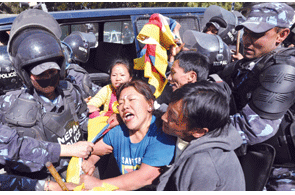
Nepalese police arrest Tibetan protesters in front of the consular section of the Chinese embassy in Kathmandu, during a protest marking the 53rd anniversary of the 1959 Tibetan Uprising on Saturday |
She worries she will be followed home and arrested again, yet the 27-year-old is one of the few Tibetans in Nepal keen to speak about what they see as an increasingly hardline approach by the government to their community.
“It’s not easy because we have no freedom. We are refugees here. Things have changed and people feel very suffocated,” she said ahead of commemorations last Saturday to mark the 1959 uprising against Chinese rule in Tibet.
For decades, Nepal has been a safe haven for Tibetans fleeing China but activists say their people’s peaceful existence is at threat because of Beijing’s growing influence over its neighbour.
Campaigners believe the wave of protests against Chinese rule that began in Tibet in March 2008 and the resulting crackdown has transformed the attitude of Nepal’s government.
Arrests of activists in Kathmandu have become frequent in recent years and the periods of detention are getting longer, activists say.
In February, police arrested 13 students protesting in front of the UN headquarters in Kathmandu, releasing them only after they had spent two weeks in jail.
“They were just taking part in a human rights protest and they were arrested. Before, when people got arrested they would be released on the same night,” said Dolma, who has been detained twice in recent months.
“We get information that they got orders from China to be kept in detention for so long.”
Nepal-born Dolma, president of the Nepal chapter of the Tibetan Youth Congress, said pre-emptive arrests and large-scale police deployment in her community were contributing to fear and insecurity.
“They don’t allow any Tibetan to do anything freely,” she told AFP.
“I don’t know what really changed but it’s all Chinese influence. It was bad but now it’s worse.”
At Saturday’s 1959 commemorations, Kathmandu police arrested 22 Tibetans for “suspicious activities” at demonstrations that were more muted than in previous years.
For three decades Nepal welcomed Tibetans into the country after the uprising, issuing them with refugee identity certificates, known as the “RC”.
But the government has refused since 1998 to issue RCs to Tibetans, including children born in Nepal to refugee parents.
“I have a lot of friends who don’t have RCs and they face so many problems. They were born here but they don’t have citizenship,” said Dolma.
“If they want to go abroad for study, they can’t. And if you want to work they require Nepali citizenship documents.”
Analysts say while India has traditionally been the influential player in Nepal, China is making inroads in a nation that is recovering after a decade-long civil war came to an end in 2006.
Impoverished Nepal, home to 20,000 exiles from Tibet, appears keen to seek further Chinese aid.
In January Chinese Premier Wen Jiabao and his Nepalese counterpart Baburam Bhattarai discussed investment from Beijing for infrastructure projects that could amount to billions of dollars.
In return, Nepal expressed support for Beijing’s “one-China” policy which states that Tibet is an integral part of China.
In the last few months rights groups including the International Commission of Jurists, Human Rights Watch and the UN Office of the High Commissioner for Human Rights, have voiced concerns over Nepal’s hardline on its Tibetan community.
And Tibetan groups such as the US-based International Campaign for Tibet say the change in attitude is increasingly apparent.
“The characterisation of peaceful Tibetan community activities and demonstrations as anti-Chinese clearly reflects China’s agenda in Nepal,” an ICT spokeswoman told AFP.