


 |
|
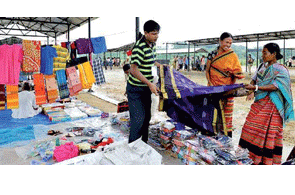
Buyers at a shop in the Kurigram border market of Bangladesh |
Dhaka
What were launched as border ‘haats’ (markets) aiming to help the villagers and bolster friendship between Bangladesh and India, have ultimately gone into the hands of a syndicate.
It is alleged that a syndicate now controls the much-hyped Baliamari-Kaliachar border market in Kurigram district of Bangladesh, driving out the poor villagers.
A report reaching Dhaka from Kurigram yesterday said that the syndicate purchases goods in bulk and sells those in the market at prices double than the retailers’. They even sell the goods outside the market at exorbitant prices.
The border market was inaugurated in July last year amid hope that it would help strengthen the friendship and increase the volume of trade between India and Bangladesh.
During a visit to the market, it was found that the sellers, in most cases, do not sell goods to the retail buyers, if they do that at all, they do that at much higher prices.
Abdus Sobhan, a resident of a border village, said he could not buy anything from the market as the sellers kept their goods in sacks for selling to wholesale buyers.
Anwar Hossain, another villager, said he had to return home empty-handed from market as prices were very high. “Seven oranges were selling at 100 taka ($1.15),” he said.
According to the villagers, the Indian sellers are more eager to sell goods in bulk as it makes the bargain easier and helps save time.
Thus shopping at the market gets beyond the means of the poor villagers.
The Indian buyers and sellers also expressed their dissatisfaction as they have to face hassles from Indian custom authorities.
Dilubin Sotma, a resident of West Garo Hill district of India, said: “We like Bangladeshi readymade garments but we can’t take those due to custom rules. We have to pay custom duty or Indian Border Security Force troops take away the goods.”
Bangladeshi traders alleged that Indian customs and BSF authorities create obstacles for their products although the sale of those goods is legitimate as per the agreement.
Besides, Indian goods are sold at much higher prices than that of Bangladeshis’, which frustrates the local traders.
More worrying is that the lone bamboo bridge made for reaching the market was washed way during the last monsoon, causing difficulties to the Bangladeshi traders and buyers.
People living within 5km radius of the market are allowed to shop at the market. Some 300 people from each country are allowed to enter the market while 25 traders from each country are supposed to sell products here. Each person can buy goods worth not more than 3,000 taka. Buying and selling is allowed in both Bangladesh and Indian currencies.
+