


 |
|
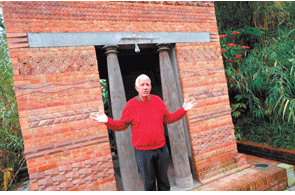
German architectural historian and winner of the Fukuoka Arts and Culture Prize 2011 Niels Gutschow, poses at his residence at Bhaktapur on the outskirts of Kathmandu |
The lasting image for tourists flying out of Kathmandu is of the multi-roofed pagodas of palaces and temples and the 16th century courtyards, which were once the basic unit of city planning.
But much of the capital’s ancient architecture will soon be no more than a memory, according to one of the world’s leading authorities, Niels Gotschow, as haphazard urbanisation and a desire for modernity change Kathmandu.
“To put things into a book is an act of preservation because one day this will be the only way to remember,” says Gutschow, who has dedicated the last four decades to chronicling and preserving Nepal’s architectural treasures.
Gutschow, 70, has pulled up countless floors and chipped endlessly at concrete to reveal the long-lost craft of the Newars - the Kathmandu Valley’s indigenous inhabitants renowned for their striking brickwork and wood carving.
The monuments of the three cities of the valley on which the German national has worked - Bhaktapur, Kathmandu and Patan - were collectively designated as the first Asian Unesco World Heritage Site in 1979.
But every year courtyards with richly-carved doors are demolished, balconies and lintels removed, and cornice and roof struts pulled down to make way for new homes.
Significant monuments, monasteries, temples and historic houses across the valley are being lost in their entirety.
“An amendment of the law now requires a demolition permit but that doesn’t mean much. There’s no enforcement because no municipality can ask the (authorities) to send a policeman to enforce the law. It’s a lawless country.”
Born in Hamburg, the son of an architect, Gutschow studied architecture at the University of Darmstadt and spent time as an apprentice carpenter in Japan in the 1960s.
He came to Nepal in 1971 to volunteer on the restoration of the Pujari Math Hindu monastery in Bhaktapur, a Newar city around 13km (eight miles) east of Kathmandu where he made a home with his wife, Wau.
Gutschow’s stock-in-trade is rescuing historical buildings from ruin with a holistic approach that takes account of ancient rites and building techniques, relying on old photographs and historical detective work.
His latest project is on the restoration of the Patan Royal Palace and the Bhandarkhal Archaeological Garden, a trove of buried archaeological treasures dating back to the 12th
century.
Architecture of Newaris, Gutschow’s three-volume labour of love 40 years in the making and the latest in a canon of work stretching to more than a dozen books, was published at the end of last year. AFP