


By Mizan Rahman/Dhaka

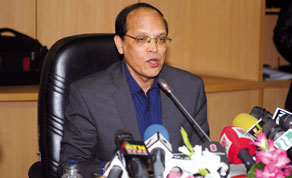
Bangladesh Bank governor Atiur Rahman at a press conference in Dhaka yesterday
Bangladesh Bank (BB), the central bank of the country, yesterday unveiled a new monetary policy with a special focus on restraining credit flow to the public sector and discouraging unproductive loans to rein in soaring inflation.
The central bank will follow a relatively tightened monetary growth path in order to curb inflationary and external sector pressures ensuring adequate private sector credit to stimulate inclusive growth, governor of BB Dr Atiur Rahman said in Dhaka yesterday.
However, the central bank now projects lower growth (gross domestic product) from the projected 7% and expects it will be in between 6.5 to 7%.
Earlier, the government of Prime Minister Sheikh Hasina, had forecast a 7% GDP growth for the current fiscal year, assuming stable domestic and global economic conditions.
Atiur announced the new monetary policy at a press conference at the central bank’s conference room.
Senior consultant and adviser to BB governor M Allah Malik Kazemi, senior economic adviser to governor Dr Hasan Jaman, deputy governors M Abul Kashem, Abu Hena M Razee Hasan, SK Sur Chowdhury and Nazneen Sultana were present.
“This monetary policy is appropriate under the present circumstances…if the government cuts borrowing from the banking sector, we’ll be able to increase credit flow to private sector,” central bank governor Dr Atiur Rahman said announcing its half-yearly monetary policy (Jan-June) of the current 2011-12 financial year.
Bangladesh Bank will ensure liquidity support for banks, so that productive credit growth is not crowded out. “It’ll remain a key area of focus for the central bank,” the policy statement said.
The central bank has set a target of 16% private sector credit growth for the January-June period, which, the bank thinks, is consistent with the projected GDP growth target and with the credit growth of other countries in the region.
It was 18% in the first half of the current fiscal year but the central bank thinks the new private sector credit growth is good.
“Credit supply to private sector will get easier if government’s bank borrowing can be kept under tolerable limits,” Atiur said while reading out the new monetary policy statement.
Private sector credit growth was 19.33% in November 2011, which was 28% in the last fiscal year. The monetary policy statement said the interest rate regime will remain liberal.
The BB will focus more on monitoring interest rate spreads so that they remain below 5% except for Small and Medium Enterprises lending (as the cost of SME operations are higher) and the consumer lending, the statement said.
The governor observed that the recent global economic condition has significantly slowed down Bangladesh’s export. The remittance inflow may also slow down. “Weak aid inflows, slowing imports and moderating credit growth will limit the aggregate demand.”
He said containing inflation is the biggest challenge for the economy right now and the bank wants to see it within single digit, which has been tenaciously staying at double digit for the last nine months. “The favourable steps will help contain the rising inflation and maintain the desired inclusive growth,” he said.
The inflation, averaging 10.7% in December 2011, is higher than the 7.5% average projected in the 2011-2012 budge.
Replying to a question on discouraging credit to unproductive sectors M Allah Malik Kazemi said the central bank does not see the capital market as an unproductive sector.
In response to another question on lowering cash reserve requirement (CRR), governor Atiur said the central bank will think of it later. “Overall import demand needs to be rationalised in order to reach the new external sector equilibrium.”