


 |
|
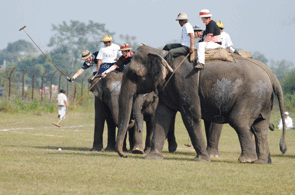
Elephant polo players from Chinggis Khaan (In Black) and Pukka Chukkas (In Blue) vie for the ball during the 30th International Elephant Polo Competition at Meghauly in Chitwan District, some 200km from Kathmandu |
This is “Champagne polo”, the commentator yells as the steed now lumbering behind the goal lets go of a large pile of dung.
We are approaching the climax of the World Elephant Polo Championships, with players from across the globe gathering in a remote airfield in southern Nepal for a week of one of the most unusual sports around.
“Some players are looking very tired out there,” says Peter Prentice, a Hong Kong-based veteran of the tournament who chairs the World Elephant Polo Association (WEPA) and doubles up as an urbane commentator.
“I recommend a few repetitions of light weights to warm down and certainly a half a Carlsberg is about the right weight to relax those weary muscles.
Meanwhile a former Miss Nepal is told she is holding her stick the wrong way around.
Thus the tone is set for the exclusive business of elephant polo in Nepal’s Chitwan National Park, home to Bengal tigers, rhinos and, for one week a year, playboys and aristocrats.
The annual event, hosted by the Tiger Tops jungle resort, has attracted models, celebrities and other glitterati over the years, including former Beatle Ringo Starr and comedians Billy Connolly and Max Boyce.
But at the business end of the tournament the participants take their sport seriously.
“Players don’t take it lightly if a umpiring decision doesn’t go their way,” says Dubai-based former Gurkha and logistics consultant
Nigel Lea, 33.
“But the joy of elephant polo is that because you are all together as a community that only sees each other once a year, 30 seconds after walking off the pitch we calm down, shake hands and have a beer together.”
It is easy to understand why the players do not like to go home empty-handed - the package per person is around the $3,500 mark for a week and the entry fee for each of the eight teams works out at an eye-watering $10,000.
“I don’t think it’s a sport for posh people,” Lea says, however. “Some people here have a lot of money, some people can hardly rub two coppers together.”
Elephant polo was dreamt up 30 years ago over drinks at a Swiss ski resort and is based on the rules of its horseback equivalent, with a smaller pitch to cater for the less energetic means of transport.
Two teams of four players in pith helmets sit astride elephants controlled by mahouts, or trainers, who drive them on using oral commands and pressure from their feet.
Communication is the main problem as the mahouts speak only Nepali, as do their mounts, who are thought to be able to understand about 30 words.
Players carry sticks up to 8ft (2.5m) long to hit the ball towards the opposing goal, with each game comprising two 10-minute chukkas.
The list of enthusiasts is illustrious. Cheering from the sidelines this year is Colonel Raj Kalaan, who played with the Indian Polo team for 20 years and commanded India’s 61st Cavalry.
Local people also turn up in their thousands every year to cheer on a team put together by the park warden and his staff, who work with elephants every day and are often among the top performers.
This year’s title was successfully defended by a team led by spritely 72-year-old Scotsman James Manclark, a former Olympic tobogganist who was one of the sport’s founders. By Frankie Taggart/AFP