


 |
|
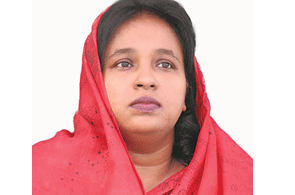
Selina Hayat Ivy, a ruling Awami League dissident, becomes first female mayor |
Dhaka
Selina Hayat Ivy, a ruling Awami League dissident, won the mayoralty of Narayanganj City Corporation in a landslide victory in Sunday’s voting, getting herself a place in Bangladesh’s history as the first female city mayor.
The Election Commission announced Ivy as the winner in the mayoral race.
According to results, she led the polls by more than 100,000 votes to defeat her nearest rival, ruling Awami League-backed Shamim Osman.
Ivy bagged 180,819 votes whereas Shamim secured 78,705 votes in the maiden election to the newly-formed city
corporation.
Around 70% votes were cast in the polls.
With the win, history also repeated for Ivy whose father Awami League leader Ali Ahmed Chunka was elected chairman of the erstwhile Narayanganj municipality, beating then ruling AL-sponsored candidate
in 1974.
Ivy herself had also run the municipality for eight years from 2003.
“It is a victory of general people who gave their verdict against misdeeds,” Ivy said in an instant reaction late last night when she was clearly ahead of Shamim with a big margin.
“I want to work for the people of Narayanganj irrespective of their political identities and creeds as the mayor,” she told reporters.
Reacting to his defeat, Shamim said: “It is a stage-managed election. If I had known about it, I would not have participated in the polls.”
“I have nothing to do even after I have now come to learn that the election is unfair. My hands are tied since I’m a ruling party-backed candidate,” he said.
Shamim expressed frustration with the elections for “behind-the-scenes move to ensure my defeat”.
“The police were persuading voters in exchange for money to cast votes for Ivy,” Shamim said.
The polling was almost peaceful amid high tension and the opposition Bangladesh Nationalist Party (BNP)-backed mayoral candidate’s last-minute withdrawal from the race on the plea of non-deployment of army.
Ivy’s supporters screamed in joy when results of different polling centres were announced. They brought out processions in the city in the evening, assuming a landslide victory of their leader.
A total of 56 female candidates contested the election for nine reserved posts for female councillor while 250 candidates vied for 27 general councillor posts.
Electronic voting machines (EVMs) were used in the polls in nine of the city’s 27 wards.
The EC had earlier named 131 of the 163 polling centres as vulnerable following allegations by different candidates.
Some 8,500 security men, including 4,000 policemen, 1,400 members of Rapid Action Battalion, 180 coastguards and 2,500 Ansar members, were deployed to ensure security.
In addition, closed-circuit TV cameras were installed in 20 polling centres.
The EC engaged 36 magistrates, including nine judicial magistrates, to lead mobile courts to prevent poll violence and anomalies.
Police and RAB members were engaged also in controlling movements of people and vehicles at several strategic points in the city.