


 |
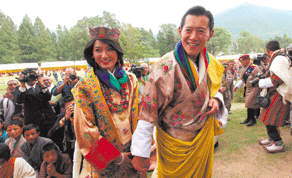
| Bhutanese King Jigme Khesar Namgyel Wangchuck and Queen Jetsun Pema react to questions on their marriage after their wedding in Punakha yesterday. |
Bhutan’s 31-year-old King Jigme Khesar Namgyel Wangchuck yesterday married his teenage sweetheart Jetsun Pema and later crowned her queen of the Himalayan kingdom.
The royal couple were married inside the 17th-century monastic fortress called the Palace of Great Happiness in the country’s old capital of Punakha.
The ancient rituals, administered by the Je Khenpo, Bhutan’s chief Buddhist abbot, began at 8.20am, an auspicious time determined by royal astrologers.
Sounds of gongs and trumpets reverberated in the fortress as the king, wearing a yellow sash, and his 21-year-old queen walked out under gilded pinnacles following the nuptials that were attended by the royal family, diplomats and dignitaries.
The ceremony began with red-robed monks chanting prayers in a Buddhist chapel earlier in the morning inside the fortress, 70km north-east of Thimphu.
The royal couple greeted each other in main courtyard after being led into the sacred fortress amid billows of incense smoke as cymbals rang out in the picturesque setting.
In the main wedding ritual, a nervous Pema prostrated herself three times before the king. She then presented him with a golden chalice, said to contain the ambrosia of eternal life, that he sipped after offering it to the guardian deities.
The young king, wearing the dynasty’s raven crown, placed a silk brocade crown on her head in front of his throne, overlooked by a huge statue of the Buddha.
Pema, formally proclaimed the new queen, sat on her throne beside the king, as monks chanted prayers to conclude the two-hour ceremony.
The king’s father, Jigme Singye Wangchuck, also gave the bride five-coloured scarves blessed at the tomb of Bhutan’s founder, Zhabdrung Ngawang Namgyal, a 17th century lama-king.
The Je Khenpo later presented eight auspicious articles to the royal couple, consisting of a mirror, medicine, curd, incense, fruit, a conch shell, vermillion and mustard. Another round of offerings followed, of objects symbolizing longevity, devotion, valour, truth and wisdom.
Oxford-educated Jigme Khesar became head of state in 2008 after his father abdicated to make way for democracy and handed power to his son as a constitutional monarch.
One of the most eligible royal bachelors, he married his sweetheart, to whom he had proposed at a family picnic in national capital Thimphu.
It was “love at the first sight,” the fifth Dragon King confessed during a meeting with students some months ago.
Pema, who studied international affairs at London’s Regents College, is the daughter of an airline pilot.
“I am happy. I have been waiting quite some time (to get married),” the king told reporters after nuptials. “She is a wonderful human being and intelligent. She and I share one big thing in common - love and passion for art.”
The wedding of the popular king, adored for his compassionate qualities and accessibility to locals, sparked large-scale celebrations across the country.
Bhutanese including nomadic yak-herders from remote villages converged at Punakha braving cold conditions, while a majority watched live coverage on TV.
“It’s as emotional as a sacred ceremony for us Bhutanese. The new queen will prove very auspicious for our country,” a Bhutanese spiritual authority, Sangye Wangchuck, said at the wedding in Punakha where celebrations concluded with a dance after a grand feast, archery competitions and song performances.
Bhutan has declared three days of national celebrations. The main public celebrations are slated for tomorrow when the royal couple join thousands of locals to witness dance and music performances at capital Thimphu’s national Changlimithang stadium.
Unlike the flamboyance of royal weddings like that of Britain’s Prince William and Kate Middleton earlier this year, the monarch desired simple and traditional celebrations, which he said would be a “family affair, and the people of Bhutan are my family.”
Bhutan is among the UN’s least-developed countries and has remained largely isolated and reclusive. The nation has developed an alternative measure of progress, quantifying its gross national happiness rather than using exclusively economic indicators to assess its development.
The country, whose local name Druk Yul means “land of thunder dragon,” has 700,000 inhabitants.
AFP adds: “You can be sure that our happiness is increasing,” joked Karma Tshiteem, the head of the Gross National Happiness Commission, which vets government policy.
Prime Minister Jigmi Thinley said the wedding was of “great significance politically” as well as a source of national pride and excitement.
“It ensures the continuity of the monarchy. Until the king gets married people are always concerned,” Thinley said. “The king’s importance in democracy hasn’t diminished. He will always be seen as the ultimate anchor.”
Security was tight around the monastery, with phone networks jammed and police enforcing strict controls on vehicles, but the royal couple later mingled openly with local villagers who turned out in their thousands.
“The king has finally got a companion who is from a noble family, and she has very good qualities,” said Bago Dem, a local resident in her 60s. “They understand the problems of the people.”
The king, who is known to invite his subjects round for tea, had requested a simple and traditional ceremony. No foreign VIPs or fellow royals were among the assembled dignitaries and friends of the couple. The Bhutanese royal family are credited with bringing stability to the formerly war-wracked nation and ensuring its independence despite giant neighbours India and China to the north and south.