


 |
|
|
Suman Howlader was thrilled to land a job in a Bangladeshi factory sandblasting new jeans to make them look old, but he now believes the diktats of fashion have exacted a heavy toll on his health.
After working for three years, he started vomiting blood, coughing badly and struggling to breathe before being admitted to a respiratory hospital in Dhaka.
Workers’ groups say Howlader and many others like him have been misdiagnosed as suffering from tuberculosis because of ignorance about silicosis - an incurable disease caused by inhalation of silica particles.
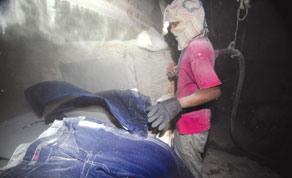
Minute, fast-moving particles are released during sandblasting, a process used to give new jeans the “worn” look that has been popular for many years around the world.
Sandblasting has long been banned in Europe and the US, but Bangladesh’s garment factories still use it to condition jeans for top western brands.
“One day, when I was working, blood started gushing out of my mouth and nose,” Howlader told AFP from his hospital bed.
“They told me the work was safe. But the constant sandblasting made the room fill up with dust and sand. You end up swallowing and inhaling a lot of it.”
Howlader fired high-pressure sand at denim jeans with just a cloth mask for protection, treating 200-300 pairs in a 10-hour day.
“Sandblasting is booming here,” said Kalpana Akhter, general secretary of the Bangladesh Center for Workers Solidarity, which records many silicosis-like symptoms among workers in the sector.
“Doctors are not looking out for silicosis, so cases get diagnosed as tuberculosis instead,” she said.
As most companies have no health insurance, many of those who become sick simply quit their jobs and return to their villages in dreadful health, she added.
Tens of thousands of Bangladeshi workers are involved and at least 500 factories use sandblasting, said Khorshed Alam, who runs a labour rights group.
“Workers hardly have any protective gear to prevent (silica) dust from entering their system,” he said.
According to Alam, many large factories are aware of the health risks of sandblasting and to avoid potential liability they often subcontract out the work to small, standalone factories.
“We use home-made compressors and sand-guns, which are 20 times cheaper than the ones used by big plants,” Delwar Hossain, supervisor at a small unit in Dhaka, told AFP.
Because of the high pay - 7,500 taka ($100) a month or double the minimum wage - they have no shortage of workers.
“In some factories, they use masks and other gear to keep sand off. But here we use cloth... there is no escape from sand. But we’ve got used to it,” he said.
The labour rights group Clean Clothes Campaign has run a successful campaign to shame famous brand names into using other, safer, techniques but in Bangladesh it remains profitable and therefore common.
Gap told AFP that it halted sandblasting at its Bangladeshi suppliers in August following a review, though for many local factory owners there is an acceptance that the needs of fashion overrule health concerns.
“We are still a LDC (‘least developed country’), please don’t think that we are Switzerland,” said Shafiul Islam Mohiuddin, head of the Bangladesh Garment Manufacturer and Exporters Association, explaining that a national ban was unlikely.
Such attitudes mean a full-scale tragedy among Bangladeshi sandblasters may be going undetected, believes Ineke Zeldenrust, a spokeswoman for the Clean Clothes Campaign.
“We worry that we will see a similar scenario in Bangladesh as in Turkey,” she said, where dozens of workers - some teenagers - developed acute silicosis and died, prompting public outcry before a ban was enacted in 2009.
But workers such as Asma, who is also being treated in a chest hospital, say they have no choice but to continue sandblasting. “The disease has eaten all my savings. If I don’t work, I can’t eat,” a gaunt and skinny Asma, 25, told AFP.