


 |
|
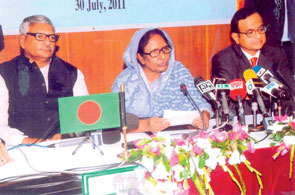
Bangladesh Home Minister Sahara Khatun and his Indian counterpart P Chidambaram, right, addressing a news conference after official talks in Dhaka yesterday |
Chidambaram’s visit to Bangladesh and his talks with his counterpart Sahara Khatun took place ahead of Indian Prime Minister Manmohan Singh’s visit to Dhaka on September 6-7.
Bangladesh and India expressed firm optimism that the issues of border demarcation and transfer of enclaves would be resolved, reported Xinhua.
“We have very constructive talks. We’re confident all these issues will be resolved before the prime minister’s visit,” Chidambaram told reporters after one-and-half-hour meeting with Bangladesh Home Minister Sahara Khatun here in Dhaka yesterday.
The border issues have remained unresolved for the past 40 years since the liberation of Bangladesh in 1971.
India and Bangladesh share some 4,100km border, of which some 6km have not been
demarcated as yet.
The enclaves - surrounded completely by the other country’s land - are 162 in number, clustered on either side of Bangladesh’s border with the district of Cooch Behar in West Bengal.
The Indian home minister said headcount of the inhabitants of the enclaves has just been completed. There are 51,000 people - 34,000 Indians and 17,000 Bangladeshis - living in the enclaves.
Chidambaram said the fate of the inhabitants will be decided by the two prime ministers when they meet in Dhaka.
The Indian minister said that India’s Border Security Force (BSF) has been instructed not to fire at people trying to cross over, but they may open fire to protect themselves and in self-defence.
Chidambaram said that “clear instructions” have been given to the Indian border guards not to open fire on any unarmed people at the border, the Daily Star reported.
“Let me make it very clear, we have issued strict instructions to our border security forces that in no circumstances should they fire upon anyone trying to cross either from Bangladesh to India or India to Bangladesh. The message has gone down to the last jawan,” he said.
“After the instructions, the numbers of incidents came down dramatically. There are only seven cases this year compared to last year’s 33,” he added at a press conference after holding talks with his Bangladeshi Home Minister Sahara Khatun.
He stressed that “the only circumstance in which India have said firing may be justified is when a gang actually attacks a BSF jawan or an office. Then, he has to protect himself and fire in self-defence”.
During the meeting, Maj. Gen. Anwar Hussain, director general of Border Guard Bangladesh, and BSF chief Raman Srivastava signed the Co-ordinated Border Management Plan (CBMP). Both countries expect this will further enhance the quality of border management.
Sahara Khatun led a 17-member Bangladesh team while Chidambaram led his 12-member delegation at the talks.
Bangladesh and India signed the agreement so as to reduce incidents of killings and crime along the border. Border guards of both countries will now exchange information on vulnerable areas to ensure joint patrolling in a coordinated manner.
Chidamabaram came to Dhaka on Friday night on a one-day visit.