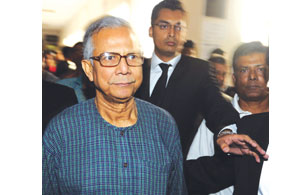
Muhammed Yunus, the Bangladeshi pioneer of “microfinance” loans to help the poor, made a final legal appeal to the Supreme Court yesterday against an order dismissing him from his own bank.

YUNUS
The Nobel laureate also asked the court to immediately suspend the central bank’s order removing him from Grameen Bank, which he founded in 1983 and which provides collateral-free loans to 8mn rural borrowers.
Yunus, 70, celebrated worldwide for tackling poverty through microfinance cash loans, has fallen out with Prime Minister Sheikh Hasina, and his supporters say he has been targeted in a bitter smear campaign.
He was fired as Grameen Bank managing director last week by the central bank and on Tuesday lost a high court appeal against his dismissal.
Backed by a high-profile international lobby group, he defied the order by returning to work at Grameen Bank’s headquarters and launching his legal battle.
“A hearing has been set for the morning of March 15 and the full bench of the Supreme Court’s appellate division, led by the country’s chief justice, will hear the case,” Tanim Hussain Shawon, one of Yunus’s lawyers, told AFP.
During a preliminary hearing yesterday, the Supreme Court refused to suspend the high court verdict, which upheld the central bank order sacking Yunus from his
position.
The central bank — which is nominally independent from the government — removed Yunus on the grounds that he had been in his position illegally, as he failed to seek its approval when he was reappointed indefinitely in 1999.
High Court judge Muhammad Mamtaj Uddin Ahmed said in his ruling Tuesday it was “crystal clear” that the central bank’s order was legal, and added that Yunus had also exceeded Grameen Bank’s mandatory retirement age of 60.
“Following the High Court verdict, Yunus is no longer the managing director of Grameen Bank,” Muzammel Huq, Grameen Bank’s government-appointed chairman, told AFP.
“Next week, the board will meet and we will set up a five-member search committee to find a new managing director for the bank,” said Huq, who is openly hostile to Yunus.
Analysts say Yunus’s troubles stem from 2007 when he floated the idea of forming a political party, earning the wrath of Prime Minister Hasina who has publicly disparaged his work.
Grameen’s huge influence in Bangladesh and its move into solar panels, mobile phones and other consumer goods also appear to have triggered the government’s animosity.
“They want to put their own person at the chair of the bank, a political person,” Yunus, who won the Nobel peace prize in 2006, told a Washington microfinance conference via video link on Monday.
Friends of Grameen, a lobby group chaired by former Irish president Mary Robinson, described the High Court verdict as “politically oriented and without legal grounds”.
His sacking sparked street protests in Bangladesh, with 500 people protesting outside the Grameen Bank headquarters on Tuesday and widespread condemnation from overseas, including from US Senator John Kerry.
Grameen Bank, which is 25 percent state-owned and employs 24,000 people, provides credit to eight million borrowers, the vast majority of them women living in rural villages.
Its work has been copied in developing countries around the world.
The United States has said it hoped for a compromise in a row between the authorities in Dhaka and Bangladesh’s Nobel laureate Muhammed Yunus, who was fired from his Grameen Bank.
US Secretary of State Hillary Clinton was due meanwhile to telephone Yunus, who cancelled a scheduled trip to Washington because of the legal challenge he filed in Bangladeshi courts, Clinton spokesman Philip Crowley said.
“We continue to follow developments closely and await clarification from the government of Bangladesh and Grameen Bank,” Crowley told reporters.
“We hope that a mutually satisfactory compromise can be achieved that will ensure Grameen Bank’s autonomy and effectiveness.” AFP