


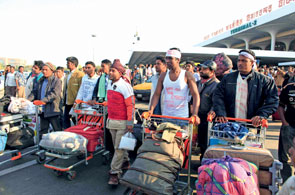
Bangladeshi migrant workers evacuated from Libya arrive at the Hazrat Shahjalal International Airport in Dhaka yesterday
Bangladesh yesterday told tens of thousands of migrant workers trapped in Libya to stay in the country, as evacuees arriving back in Dhaka said they had been abandoned by their government.

About 60,000 Bangladeshis working on construction sites in Libya have struggled to escape since the violent rebellion against Moamer Kadhafi began, with Dhaka officials admitting they had no resources to send ships or planes.
At least 7,500 Bangladeshis have left, but those that remain are being advised by the government not to leave — even though the UN High Commission for Refugees has called for a mass evacuation.
“We are discouraging those Bangladeshis who are still in Libya from coming back. These are poor workers. We are afraid if they come back they will lose everything,” Bangladesh’s manpower secretary Zafar Ahmed Khan told AFP.
“If they are not in direct danger, we advise them to stay where they are.”
While many countries implemented major rescue operations for expatriates, impoverished Bangladesh has relied on private companies to evacuate their staff and on the International Organisation for Migration (IOM).
“There were no embassy officials at the border. Other countries’ officials were processing visas and giving food to their workers. We had no one to help us,” said Monir Hossain, a migrant who returned home after crossing the Egyptian border.
“I am lucky because my company financed my return. Thousands more were living there with little food and in extreme cold,” he told AFP.
Some 750 migrants were set to land in Dhaka later yesterday after the IOM arranged flights, following 110 who arrived on Tuesday when their private employers organised evacuation.
One worker who had returned to Dhaka said Bangladeshi migrants still in Libya faced starvation due to the lack of consular assistance.
“The situation is very bad. We went to the Tunisian border and lived on the leftovers of workers from other countries. We didn’t have any food, any money or any embassy officials to help,” he told a local television channel.
“If the situation continues a few more days, a lot of Bangladesh workers will simply die because of lack of food,” he said.
At least 60,000 Bangladeshis were working in Libya, mostly on construction sites at foreign-owned companies, when unrest against Kadhafi’s four-decade long regime began.
Families of workers in Libya have protested across Bangladesh, accusing the government of failing to protect its
nationals.
Many Bangladeshi migrants put themselves in debt to recruitment agencies to secure comparatively well-paid work in Libya. AFP