


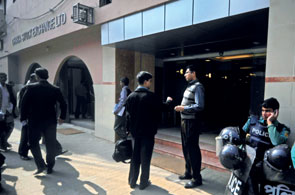
Police personnel sit near the Dhaka Stock Exchange in Dhaka yesterday
Bangladesh shares ended sharply higher yesterday, a day after a steep plunge forced the bourse to suspend trading and sparked violent street protests by angry investors which were broken up by the police.

The Dhaka Stock Exchange’s benchmark General Index closed 15.58%, with 243 shares up and only five down. The bourse suffered its biggest crash ever on Monday which led authorities to suspend trading after 50 minutes in response to a 8.9% decline.
Shares, battered for weeks, had sunk 6.7% on Sunday.
Analysts said investors had been encouraged by measures taken by the Securities and Exchange Commission, the market regulator, to relax the limit on how much buyers can borrow from their brokers to invest.
“All these decisions have encouraged investors to inject funds into the market and that helped the rise in the market today,” said Mostaque Ahmed Sadeque of Investment Promotion Services.
Last month, the International Monetary Fund warned banks had too much exposure to the stock market and suggested central bank to take corrective action.
Some banks had invested 75% of their deposits in the stock market against a ceiling of 10% and had been told to get back under the limit by January 15. This rule has now been eased.
Sentiment was also boosted by the central bank’s extension of a deadline for banks to adjust the vast amounts of loans that had been diverted from the industrial sector to capital markets.
The government will soon offload stakes in dozens of state-run enterprises, a move which analysts said would help cool down prices as supply of shares would increase.
Analysts said the index was likely to fall further before stabilising at between 6,500 and 7,000 points. Before the recent crash, the index rose to nearly 9,000 points.
“Issuance of more initial public offerings (IPOs) will help stabilise the market,” said A B M Mirza Azizul Islam, a former financial adviser to the government.
He said the stock market volatility did not constitute a major political threat to the government.
But the crash, and the protests, had prompted Prime Minister Sheikh Hasina to ask the stock market authorities to intervene, indicating the government was concerned as many investors in the Bangladesh’s Dhaka and Chittagong exchanges are individuals with modest means who have taken out large loans to invest in shares to improve living standards.
Individual investors numbered fewer than 500,000 in 2006, with the number since rising to more than 3mn.
“The income from share trading helped to run my family, send my children to schools and meet other requirements,” Raqibul Haque, a small investor who funded stock purchases by selling his wife’s jewellery, told Reuters.
“But I felt so helpless as prices fell sharply over the past weeks.”
Police said they expected no recurrence of Monday’s turmoil, when thousands of investors vandalised cars and blocked roads around the exchange, before police fired tear gas and used water cannon to disperse them. There were also protests in Chittagong and other major towns.
Prices of shares nearly doubled in 2010, encouraging a stream of new investors to enter the stock market.
Persistent declines since early last month unleashed a series of street protests, prompting the stock market regulator and the central bank to take measures to cool the market.
The benchmark Dhaka Stock Exchange index has lost more than 27% since December 5.
The market, which surged by more than 80% in 2010, lost its value by $9bn in the trading week of January 2-10, the DSE said. Reuters