


 |
|
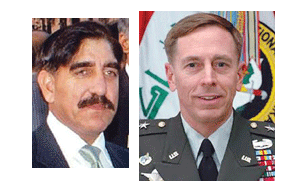
Lt. Gen. Zaheer ul-Islam, David Petraeus |
Lieutenant General Zaheer ul-Islam, the new head of the Inter-Services Intelligence (ISI) agency, is paying the first visit to Washington in a year by the leader of Pakistan’s powerful spy body.
Islam met Thursday with Central Intelligence Agency director David Petraeus and held “substantive, professional and productive” talks, a senior US official said on condition of anonymity.
“The talks provided an opportunity to discuss a number of proposals for how we can enhance our joint efforts against terrorism,” the official said.
“Both leaders reaffirmed their commitment to work together to counter the terrorist presence in the region that threatens both US and Pakistani national security,” he said.
The official did not go into further detail. The United States has been looking for ways to co-operate with the ISI, whose relationship with US spies has swung from friendly to hostile in recent years.
The remarks echo those of the US commander in Afghanistan, General John Allen, who on a visit to Pakistan on Thursday praised “significant progress” in improving co-operation between the two countries.
Pakistani intelligence and the military were humiliated in May last year when US forces secretly penetrated the country and killed the world’s most wanted man Osama bin Laden, who was living in the army town of Abbottabad.
Pakistan shut down supply routes into Afghanistan — its key form of support to US forces since the September 11, 2001 attacks — after US forces killed 24 Pakistani troops in a border raid in November.
Tensions have since eased, with Pakistan reopening the routes after Secretary of State Hillary Clinton last month apologised for the deaths. Pakistan on Tuesday signed a deal to keep the border open to convoys until the end of 2015, by which time the United States plans to withdraw most forces.
Frustrated with Pakistan, US intelligence has defiantly carried out drone attacks deep inside the country, despite Islamabad’s protests that the unmanned strikes violate its sovereignty.
Sources at the CIA office revealed that “no operational details” were charted out so far, though the spy masters of both the countries were keen to present each other’s points of view.
US officials again asked Pakistan to take action against the notorious Haqqani Network, while the Pakistani side emphasised increased intelligence sharing.
Lt Gen Zaheerul Islam’s numerous meetings in just one day reflected the US interest to work with the new Pakistani intelligence chief.
Many US officials, including intelligence agency officials and members of the Congress, met Lt Gen Islam all the day until the wee hours. No further details of the issues discussed have been made public by either side.
The embassy of Pakistan declined to comment on the DG’s schedule. A senior US official privy to the situation hinted that top US commander in Afghanistan, Gen Allen’s meeting with Pakistan Army Chief Gen Kayani at the same time as the agency heads were discussing the security issues indicated that Pakistan and the US were working on a co-ordinated strategy of sorts.
A source in the administration said that both the parties mainly discussed mutual challenges in the war on terror and possible ways to move forward on joint concerns. Things had changed, the source added, and they wanted to move on from post-Raymond Davis situation.
A new chief with restored relationship after the restoration of Nato supply lines and release of CSF worked as a confidence building measure. “It’s an opportunity to continue building upon the growing operational co-operation among the Americans and Pakistanis,” the source said.
Certain members of the Congress were eager to exchange views with the Pakistani delegation, especially those who had been quite critical of the ISI in the past year. Agencies