AFP/Islamabad
A bomb explosion killed at least eight people, including six Shia pilgrims, in Pakistan’s insurgency-torn southwest yesterday, police said.

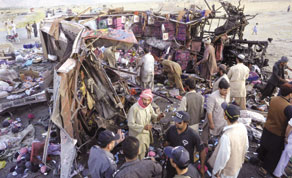
Pakistani volunteers search the wreckage of a destroyed bus after a bomb explosion on the outskirts of Quetta yesterday
The incident took place in Hazar Ganji area on the outskirts of Quetta city, the capital of the oil and gas rich Baluchistan province bordering Iran and Afghanistan.
“A bus carrying Pakistani Shia Muslims was coming to Quetta from Iran when a bomb exploded near it, killing eight people including six Shia pilgrims and two escorting policemen,” senior local police official, Hamid Shakeel, said.
“Our initial investigation suggests it was a remote controlled device planted along the road,” he said.
Another senior local police official, Sikandar Tareen, confirmed the casualties.
Baluchistan has become an increasing flashpoint for sectarian violence between Pakistan’s majority Sunni Muslims and minority Shias, who account for around a fifth of the country’s 167mn population.
Baluchistan is also rife with Islamist militancy and a regional insurgency waged by separatists who rose up in 2004 demanding political autonomy and a greater share of profits from the region’s wealth of natural resources.
Meanwhile, a remote-controlled bomb blast killed eight Pakistani troops and wounded three others yesterday in a restive Pakistani tribal region near the Afghan border, officials said.
The incident took place in Bara, the main town in the lawless Khyber tribal region where Taliban and Al Qaeda-linked militants have carved out strongholds.
“At least eight troops including an officer were killed and three others wounded in a bomb explosion, targeting two vehicles of the paramilitary Frontier Corps (FC),” a spokesman for the force said.
The vehicles were on a routine patrol when attack happened, he added.
Earlier, the spokesman had said that four troops were killed and six wounded.
Local government official Nasir Khan also confirmed the new toll.
Elsewhere in the northwestern Haripur district, three Pakistani men, allegedly arrested by security forces when they disappeared a year ago, were found dead yesterday after authorities ordered that they be produced alive in court.
The case spotlights the plight of the “missing” in Pakistan, where judges are seeking to bring the powerful military and intelligence agencies to book over mass arrests of alleged terror suspects, who are never seen again.
According to a preliminary autopsy report, the three men aged 30 to 35 were recently killed—first poisoned, then their necks were broken.
Their bodies were discovered in the district of Haripur, part of the northwest where the army has been fighting to put down a Taliban insurgency. “The dead bodies were recovered from three different places,” Mohamed Ali Gandapur, district police chief, told AFP.
He said police were investigating who killed them and why.
Relatives of one of the victims told police he was arrested by security forces and had been missing for 11 months, Gandapur said.
Television footage showed the bodies being taken away by ambulance, accompanied by relatives and rescue workers.
A senior police official, speaking only on condition of anonymity, said the victims had been arrested by intelligence agencies.
An unnamed relative said the victims were three of 170 missing people ordered to be produced court by judges in the northwestern capital Peshawar.
On Wednesday a bomb planted under a tea stall at a railway station in southwestern Pakistan killed seven people, including a child, and wounded 18 others, police said yesterday.
The explosion appeared to target the express train from the southwestern city of Quetta en route to Rawalpindi, the capital’s twin city to the north, as it arrived at Sibi station, officials said.