


 |
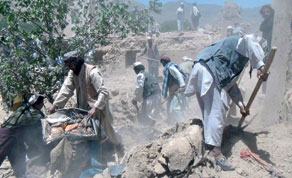
| Afghan men search for the bodies of people killed in a Nato airstrike in Logar province yesterday |
A pair of suicide bombers struck outside Nato’s biggest base in southern Afghanistan yesterday, killing 20 civilians and wounding 50, officials said, in one of the bloodiest attacks in recent weeks. And officials and villagers in Logar province, about 30 km south of Kabul, said a Nato air strike killed 18 civilians, including women and children, along with six Taliban insurgents.
The Nato-led International Security Assistance Force said there was an air strike in the area during a raid on a Taliban commander, but there were no civilian deaths. It said two women received non life-threatening injuries and that a number of insurgents were killed.
Four provincial governors from the south were at a meeting at the sprawling Nato base in Kandahar when the twin suicide attacks took place, General Abdul Hameed, Afghan army commander for the southern region, said.
A bomber on a motorcycle blew himself up in a parking lot near the base packed with truck drivers and other civilians waiting to get into the facility.
A few minutes later, as people gathered at the site of the blast, another bomber on foot walked into the crowd and detonated his explosives, said Ahmad Faisal, a spokesman for the provincial governor.
A spokesman for the Nato-led force said the coalition was aware of the incident, but directed all questions to civilian authorities.
Violence has surged across Afghanistan since the Taliban began a spring offensive in April, vowing to target the Afghan government and security forces, as well as the 130,000 foreign troops in the country.
Kandahar, the birthplace of the Taliban, has seen some of the worst attacks.
The violence has stoked concern that Afghan forces may struggle against a Taliban insurgency at its deadliest once most Western combat troops leave by the end of 2014.
Ahead of the handover, foreign and Afghan forces have stepped up operations in the southern and eastern strongholds of the Taliban.
Yesterday, the coalition and Afghan forces conducted an operation in the Baraki Barak district of Logar province against a Taliban commander.
Rais Khan Sadiq, the senior police detective for Logar, said 18 civilians were killed in the air strike that followed the raid - five women, seven children and six men, three of them elderly.
“The air strike was on two houses,” he said. Six insurgents were also killed, he said.
But Nato spokesman Major Martyn Crighton said the coalition had received no information on civilian deaths.
“We can confirm there was an Afghan and coalition mission in Baraki Barak district last night or early this morning. We can confirm in follow-on assessments the security force discovered two women who had sustained non-life-threatening injuries,” he said, adding they were treated at an ISAF facility.
“Beyond that, we don’t have anything at this stage,” he said.
President Hamid Karzai has repeatedly warned against civilian casualties in military operations. He said last month that a strategic partnership agreement signed with the United States was at risk of becoming “meaningless” if Afghans did not feel safe.
A little over a week ago, Karzai ordered an investigation after Afghan officials said a Nato air strike killed a family of eight, including six children, in eastern Afghanistan.
Two weeks before that, Karzai summoned ISAF commander General John Allen and US Ambassador Ryan Crocker to the presidential palace after a number of civilians were killed in other Nato air strikes.
For the past five years the number of civilians killed in the war has risen steadily, reaching a record of 3,021 in 2011, with the vast majority caused by insurgents, the United Nations says.
Kandahar Air Base is the largest Nato military base in southern Afghanistan, which has been a flashpoint for the insurgency over the past decade.
The Taliban have in the past threatened to kill truckers working for Nato, which relies on civilian vehicles to supply their bases across Afghanistan.
The lorries go through complex security checks that can take days, so that dozens of trucks often mass outside military bases before being allowed inside to offload their cargo, attracting makeshift bazaars as they wait.