


 |
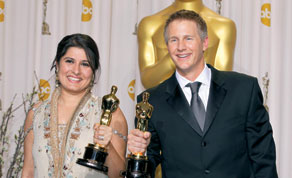
| Directors Sharmeen Obaid-Chinoy (left) and Daniel Junge, winners of the Best Documentary Short Subject for the film Saving Face, pose with their Oscars during the 84th Academy Awards in Hollywood |
A Pakistani director won her country’s first Oscar yesterday for Saving Face, a short documentary about acid attacks on women and those who help them recover.
The film by Sharmeen Obaid-Chinoy follows survivors among hundreds of people attacked every year, and focuses on British Pakistani plastic surgeon Mohamed Jawad, who returned to his homeland to help restore their faces and lives.
“Daniel and I want to dedicate this award to all the heroes working on the ground in Pakistan including Dr Mohamed Jawad who’s here with us today,” said Obaid-Chinoy, referring to her co-director Daniel Junge.
Jawad was the plastic surgeon “working on rehabilitating all these women” including “Rukhsana and Zakia who are our main subjects of the film, whose resilience and bravery in the face of such adversity is admirable,” she added.
She paid tribute to “all the women in Pakistan who are working for change,” saying: “Don’t give up on your dreams. This is for you.”
Twitter followers in Pakistan erupted with joy at news of the Oscar, falling over themselves with praise for her win and delighted that Pakistan was making headlines for something other than Al Qaeda, the Taliban and bomb attacks.
In Islamabad, Prime Minister Yousuf Raza Gilani was quick to congratulate Obaid-Chinoy and said she would receive “a high civil award.”
Her mother Saba spoke of the family’s delight at her eldest daughter’s win and called on Pakistani parents to support their daughters in a country where women can be treated as second-class citizens. “She is very happy. I am proud of my daughter. She has brought happiness for the family and the entire country. It is a great honour,” she said.
“We all supported Sharmeen in her endeavours and she has made Pakistan proud... I have a message for all the fellow Pakistanis to support their daughters because our daughters have immense talent to the country.”
Obaid-Chinoy was born in 1978 and brought up in the southern port city of Karachi. She received a bachelors degree from Smith College and went on to complete two masters degree from Stanford University.
Fellow Pakistani documentary filmmaker and multi-media expert, Musadiq Sanwal, said the prize was recognition of the fact that Pakistan was gaining a voice of its own in international culture.
“Sharmeen’s documentary and it’s winning an Oscar shows Pakistan is creating its own narrative and gaining its own voice internationally,” Sanwal said.
“Earlier, Pakistan had no voice at all to describe its strength and weaknesses, but now such efforts give it emancipation and power.”
Marvi Memon, a former Pakistani lawmaker, who campaigned for tougher penalties for the perpetrators of acid attacks and played a role in the documentary, congratulated the Pakistani director.
“I congratulate her. So proud of her,” she said simply.
Across the country, people were happy, in particular women.
“It is great to see we are full of talent. Every Pakistani should be proud,” said Shumaila Azmat, 29, an executive in a private Karachi firm.
“What is even more heartening is to see that a Pakistani woman has won an Oscar.”