AFP/Islamabad
Pakistan yesterday denied provoking Nato air strikes that killed 24 Pakistani soldiers and refused to accept expressions of regret over the cross-border attack that has inflamed US-Pakistani ties.

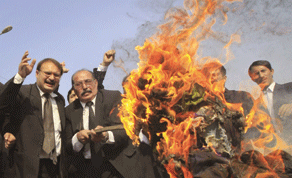
Lawyers burn an effigy of US President Barack Obama protesting against a Nato cross-border attack, in Peshawar, yesterday
Nato and the United States sought to limit the fallout of Saturday’s attack as Pakistan shut vital supply routes to the 140,000 foreign troops serving in Afghanistan and ordered a review of its US alliance.
Washington has backed a full inquiry and sent its condolences, while Nato chief Anders Fogh Rasmussen has spoken of regret over the “tragic, unintended” killings, but stopped short Sunday of issuing a full apology.
But Pakistan has dug in its heels, reacting furiously to what it called an “unprovoked” strike, worsening US-Pakistani relations already in crisis after the killing in May of Osama bin Laden north of Islamabad by US special forces.
Few questions have been answered about what exactly happened at the dead of night in some of the most hostile terrain on Earth, after reports that Pakistani soldiers opened fire first on US and Afghan forces.
The Wall Street Journal, following a similar report by Britain’s Guardian newspaper, cited three Afghan officials and one Western official as saying the air raid was called in to shield allied forces targeting Taliban fighters.
Nato and Afghan forces “were fired on from a Pakistani army base”, the unnamed Western official told the Journal. “It was a defensive action.”
An Afghan official said the Kabul government believes the fire came from the Pakistani military base — and not from insurgents. Afghan-Pakistani relations suffer from routine mutual recriminations.
An Afghan border police commander, speaking on condition of anonymity because officials have been told not to speak to media before an investigation is completed, said Nato troops hardly ever open fire unless they are attacked.
“To me it’s almost clear that they (ISAF) came under fire from that area. Without that they would have not returned fire,” he said.
He said Taliban, Afghan security forces as well Pakistani security forces have posts very close to each other due to the rugged, mountainous terrain.
“This is not true. They are making up excuses. And by the way, what are their losses, casualties?” Major General Athar Abbas, Pakistan’s chief military spokesman, wrote to AFP in a text message.
He told Pakistani television channel Geo that 72 Pakistani soldiers have been killed and 250 wounded by fire from across the Afghan border over the last three years.
Asked about expressions of regret by Nato he said: “We do not accept it because such kind of attacks have been taking place in the past... Our leadership will decide about further reaction.”
British newspaper The Daily Telegraph yesterday quoted wounded survivors of the raid, who insisted they were victims of an unprovoked attack.
Amirzeb Khan, 23, was quoted as saying that the area around the checkpoints, about 3km from the border, had been cleared of militants and the night had been quiet before the attack early Saturday.
In retaliation, Islamabad has blocked Nato convoys from crossing into Afghanistan, ordered a review of its alliance with the US and is mulling whether to boycott a key conference on Afghanistan next month.
Nato says that for now its troops will not be affected by the disruption. Meanwhile, Key Pakistan ally China said yesterday it was “deeply shocked” by Nato air strikes and called for an investigation into the incident.
“China is deeply shocked at the incident and expresses strong concerns and deep condolences to the victims in Pakistan,” foreign ministry spokesman Hong Lei told a regular news briefing.
“China believes that Pakistan’s independent sovereignty and territory should be respected and that this incident should be earnestly investigated and handled in a serious manner.”
Hundreds of enraged Pakistanis took to the streets for a third day on yesterday, blocking roads to demand that Pakistan end its troubled alliance with the United States.
On the Fox News Sunday talk show, US lawmakers vented frustration over Pakistan, with Republican Senator Jon Kyl demanding Islamabad co-operate with the United States in order to maintain billions of dollars in financial aid.
But John Bolton, a former US ambassador to the United Nations, laid bare the dilemma for Washington in handling nuclear-armed Pakistan, which has received up to $20bn in US aid over the last 10 years.
“As long as that country has nuclear weapons that could fall into the hands of radicals and be a threat worldwide, they have incredible leverage,” he said.
Pakistan’s army pleaded with Nato to stop strikes
US-led air strikes that killed 24 Pakistani soldiers lasted for two hours and continued even after commanders pleaded with coalition forces to stop, army chiefs said yesterday.
Nato described the deaths on Saturday as “tragic and unintended” and has promised a full investigation.
But Pakistani major general Athar Abbas said troops at two border posts were the victims of unprovoked aggression. He said commanders had contacted Nato counterparts while the attack was going on, asking “get this fire to cease”.
Afghan officials claimed today a joint Nato force in Afghanistan called in air strikes after fire from the direction of the Pakistani posts — denied by Pakistan.
The Pakistan army has previously said its soldiers retaliated “with all weapons available” to the attack.
Maj-Gen Abbas dismissed Afghanistan’s claims that the joint Afghan-Nato troops were fired upon first.