


 |
|
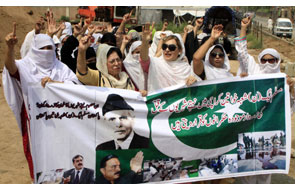
Supporters of Pakistan Muslim League (N) in Peshawar shout slogans during a protest against target killing in Karachi, yesterday |
Police and paramilitary troops were ordered on Friday to shoot on sight in Pakistan’s largest city, where an extra 1,000 paramilitary personnel were also deployed to control violence in multi-ethnic, lower middle class neighbourhoods.
“Our personnel have entered the area and are working to take full control,” said a security police official, who did not want to be identified.
A police spokesman said 157 people had been arrested in the operation since last night, and 38 pistols and three AK-47 rifles recovered.
A paramilitary Rangers spokesman said troops had rescued hundreds of people trapped in the troubled areas since last night.
“We have moved several families to safer places, and this exercise is continuing at the moment as well. The number of people evacuated so far is in the hundreds,” he said.
Interior minister Rehman Malik told reporters “Our paramilitary soldiers have secured the troubled localities and hills where armed terrorists were firing on innocent people, and have restored normal life,”.
“We’ll treat anyone who disrupts Pakistan’s financial capital as a supporter of Taliban and an enemy operating against our war on terror,” he said.
Home ministry spokesman Sharafuddin Memon said a 12-year-old boy hit by a stray bullet in Baldia neighbourhood early Saturday was also among the dead.
“More than 100 suspects, many of them with weapons, have been arrested,” Memon said.
According to police data, up to 98 people have been killed since the violence began on Tuesday, while more than 150 people have been wounded.
Karachi, home to more than 18mn people, has a long history of ethnic, religious and sectarian violence.
It was a main target of Al Qaeda-linked militants after the Sept. 11 2001 attacks on the United States, when Pakistan joined the US-led campaign against militancy.
A recent report from the Human Rights Commission of Pakistan said 1,138 people were killed in Karachi in the first six months of 2011, of whom 490 were victims of political, ethnic and sectarian violence.
The city was completely shut on Friday and public transport idled after the city’s dominant political party, the Muttahida Qaumi Movement (MQM), announced a day of mourning in response to the latest violence.
But shops started reopening yesterday and public transport returned to the roads, though people were still cautious.
“I have opened my shop today but I will see how the situation goes, and if it remains uncertain, I will close early,” said Mohamed Zafar, a bakery owner.
The latest surge in violence in the southern city came days after the MQM announced it was quitting the ruling coalition.
The MQM, which mostly represents the Mohajirs — descendents of Urdu-speakers who migrated from India after the creation of Pakistan in 1947 -- and its rival, the ethnic Pashtun-based Awami National Party (ANP), are blamed for most of the violence, though both parties deny the charges.
In some ways, Karachi raises more troubling questions over Pakistan’s stability than the northwest border regions seen as a global hub for militants and a huge concern for the West.
As the commercial hub, any trouble could disturb industrial activity, and have serious consequences for the economy.
Amnesty International criticised the government for failing to control the violence in Karachi, and raised questions over its orders to “shoot on sight”.
“By granting security forces the power to ‘shoot on sight’ the Pakistani government is effectively declaring Karachi a war zone,” Amnesty’s Asia-Pacific Director Sam Zarifi said in a statement. “Given the Pakistani army’s record of human rights violations and impunity, such licence given to the security forces, in a volatile situation, can only be a recipe for disaster, encouraging lawlessness, further violence and killings.”