


 |
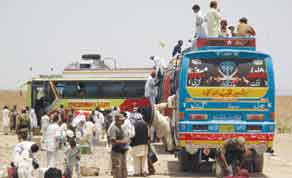
| Pakistani tribal families board buses transporting them back to their homes in South Waziristan, at Kour Internally Displaced People (IDP) camp in Tank district yesterday. At least 500 Pakistani families have returned to South Waziristan with UN and government help to rebuild their lives since major fighting broke out against the Taliban |
Most of them have returned homes over the past two months in Bajaur Agency, while a smaller number have gone to neighbouring Mohmand Agency. Both agencies are in the northern part of Federally Administered Tribal Areas, bordering Afghanistan.
They were assisted in leaving the Jalozai camp - the largest of the area’s four camps for internally displaced near the north-western city of Peshawar, said the UN High Commissioner for Refugees (UNHCR) statement.
The government of Pakistan, which organised the voluntary return operation, has declared all of Bajaur, with the exception of Loi Sam, to be safe.
It is currently working to identify an alternative site inside Bajaur Agency for the approximately 3,000 families who were living in Loi Sam and whose homes have been damaged by fighting. Areas declared safe in Mohmand include Lower Mohmand and parts of Upper Mohmand.
Displacement from Pakistan’s Tribal Areas began in 2008 in the wake of a government crackdown on insurgents. UNHCR assisted the government by funding the transportation of returnees.
“We also established warehouses in Khar in Bajaur Agency and in Ghalanai in Mohmand. Returning families were provided with basic household supplies.
Tents were also given to those whose homes were damaged in the conflict for use as temporary shelters while repairs are carried out. Other UN agencies are also providing help,” the statement said.
At the peak of the displacement crisis in 2009, more than 21,000 families (around 147,000 people) were registered in Jalozai, however, the vast majority of the displaced - around 90% - lived outside camps, with friends, relatives and in rented accommodation. An estimated 5,000 families (26,000 individuals) remain in Jalozai, most of them residents of areas still considered unsafe for returns.