


 |
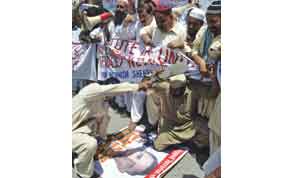
| Pakistani protesters beat a poster of US President Barack Obama with shoes during an anti-US demonstration in Multan yesterday |
Prime Minister Yousuf Raza Gilani is scheduled to “take the nation into confidence” in parliament today, his first statement to the people more than a week after the attack embarrassed the country and raised fears of a new rift between Islamabad and Washington.
Suspicion has deepened that Pakistan’s pervasive Inter-Services Intelligence (ISI) spy agency, which has a long history of contacts with militant groups, may have had ties with the Al Qaeda leader — or that at least some of its agents did.
Pakistan has dismissed such suggestions and says it has paid the highest price in human life and money supporting the US war on militancy launched after bin Laden’s followers staged the September 11, 2001, attacks on America.
The US national security adviser said that while bin Laden’s residence for several years in a compound in Abbottabad, 50km north of Islamabad, “needs to be investigated”, there was nothing to suggest the government or security establishment knew he was there.
“I can tell you directly that I’ve not seen evidence that would tell us that the political, the military, or the intelligence leadership had foreknowledge of bin Laden,” Tom Donilon told NBC’s “Meet the Press” when asked if Pakistan was guilty of harbouring the Al Qaeda leader.
“How could this have happened in Pakistan?” Donilon said.
“We need to investigate it. We need to work with the Pakistanis.
And we’re pressing the Pakistanis on this investigation.”
Donilon said Pakistani officials also needed to provide US authorities with intelligence they had gathered from the compound where bin Laden was killed, and access to three wives who are in Pakistani custody.
But he added that despite difficulties in the US-Pakistani relationship, “We’ve also had to work very closely with Pakistan in our counter-terror efforts. More terrorists and extremists have been captured or killed in Pakistan than anyplace else.”
Pakistani security officials reacted with scepticism to a US assertion that bin Laden was actively engaged in directing his far-flung network from his compound in Abbottabad where he was killed on May 2.
Washington said on Saturday that, based on a trove of documents and computer equipment seized in the raid, bin Laden’s hideout was an “active command and control centre” for Al Qaeda where he was involved in plotting future attacks on the US.
“It sounds ridiculous,” said a senior Pakistani intelligence official. “It doesn’t sound like he was running a terror network.”
Pakistani officials said the fact that there was no internet connection or even telephone line into the compound where the world’s most-wanted man was hiding raised doubts about his centrality to Al Qaeda.
Analysts have long maintained that, years before bin Laden’s death, Al Qaeda had fragmented into a decentralised group that operated tactically without him.
“It’s bull,” said a senior Pakistani security official, when quizzed on a US intelligence official’s assertion that bin Laden had been “active in operational planning and in driving tactical decisions” of the Islamist militant group from his hideout.
On Saturday, the White House released five video clips of bin Laden taken from the compound, most of them showing the Al Qaeda leader, his beard dyed black, evidently rehearsing the video-taped speeches he sometimes distributed to his followers.
None of the videos was released with sound. A US intelligence official said it had been removed because the US did not want to transmit bin Laden’s propaganda. But he said they contained the usual criticism of the US as well as capitalism.
While several video segments showed him rehearsing, one showed an ageing and grey-bearded bin Laden in a scruffy room, wrapped in a blanket and wearing a ski cap while watching videotapes of himself.
“This compound in Abbottabad was an active command and control centre for Al Qaeda’s top leader and it’s clear ... that he was not just a strategic thinker for the group,” the US intelligence official said in Washington.
“He was active in operational planning and in driving tactical decisions.”
The duelling narratives of bin Laden reflect both Washington’s and Islamabad’s interests in peddling their own versions of bin Laden’s hidden life behind the walls of his compound.
Stressing bin Laden’s weakness makes his discovery just a few minutes’ walk from a military academy less embarrassing for Pakistan, but playing up his importance makes the US operation all the more victorious.
The competing claims came as senior Pakistani officials said bin Laden may have lived in Pakistan for more than seven years before he was shot dead.