


 |
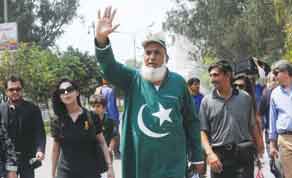
| Chaudhry Abdul Jalil (centre), popularly known as ‘Chacha Cricket’, waves after crossing the India-Pakistan border in Wagah yesterday, on the eve of the India-Pakistan Cricket World Cup semi-final match. India will face Pakistan in an ICC Cricket World Cup semi-final match in Mohali today |
Cricket-crazy Pakistanis are desperately waiting for Wednesday’s showdown with India in the northern Indian town of Mohali, where the two nations will battle it out for a place in the cricket World Cup final. And for many, victory against India is even more important than winning the tournament.
But the event could serve a wider purpose.
Billed “cricket diplomacy”, after Indian Prime Minister Manmohan Singh invited his Pakistani counterpart to watch the match, Singh’s invitation coincides with the tentative resumption of formal talks between the two nuclear-armed South Asian rivals. Contact was broken after the attacks by Pakistan-based militants in 2008 on the Indian city of Mumbai, which killed 166 people.
The two countries’ home secretaries met on Monday and Tuesday and had what both sides said were “positive” talks.
“The talks are extremely positive,” GK Pillai, Indian home secretary, told reporters after the bilateral talks ended on Tuesday. “We have moved forward, and the trust deficit has reduced.”
In a major confidence-building move, Pakistan will allow Indian investigators to travel to Pakistan to probe the Mumbai attacks for the first time.
“Pakistan conveyed its readiness, in principle, based upon the principle of comity and reciprocity, to entertain a commission from India with respect to Mumbai terror attack investigations,” a joint statement said.
But in a country obsessed with the game, many people insist that winning the match against a traditional rival is a more immediate concern than improving relations.
“Politics can be discussed later. It’s not time for politics. Our aim should be winning the game,” Mohamed Ajmal, a accountancy student in one Islamabad college said.
He considers the India-Pakistan contest even more important than the World Cup final. “If our prime minister is going there, then it is good booster” for morale.
Today’s match has dominated Pakistan’s media coverage, and the lives of many.
In the country’s biggest city of Karachi, many private firms have announced a half-day today, so people can watch from the first ball of the afternoon match.
Civic bodies and the business community are putting up giant television screens in social clubs and open spaces so people can watch the match. In a Karachi prison, where 200 Indian prisoners are being held, authorities are planning to install a big screen for them to watch the match along with Pakistani inmates.
Cinemas in the major cities will stop screening movies and will show the match on the mega-screens.
“We have five houses with a seating capacity for over 1,000 people. Tickets for all the five houses have been sold out four days ago,” Zeeshan Masih, an official with Cinepax cinema in Rawalpindi said. “There is huge excitement but we cannot accommodate huge crowds.”
Enthusiastic fans have bought thousands of replica Pakistani cricket T-shirts ahead of the show-down, and shopkeepers said they were running out of stock.
“I have already sold more than 3,000 shirts, and am still running short of supplies. There is a huge excitement for this match. I have never seen anything like this before,” said Salman Iqbal at the Lords Sports shop in Karachi’s upmarket Clifton area.
Muslim clerics have led special prayers for success in mosques and Islamic seminaries — success that would also bring personal rewards for the Pakistan cricket team.
Punjab Chief Minister Shahbaz Sharif has announced a gift of 25 acres of land to each member of Pakistan squad if they beat India.
On Monday night, Gilani called Pakistani skipper Shahid Afridi to wish him luck and convey “the sentiments and prayers of the whole nation for the success of the team”.
“Irrespective of the result of the match the team should demonstrate the best of sportsmanship and dedication to contest,” Gilani’s office said in a statement.
Sadia Khursheed, a student echoed similar sentiments.
“Let’s not mix it with politics ... It’s just a game, not a battle of religions or anything else.”