


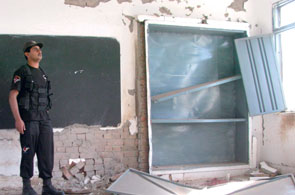
Pakistan security officials inspect the scene of a destroyed girls school building on the outskirts of Bannu, a town in militancy-hit Khyber-Pakhtunkhwa province yesterday. Unknown miscreants blew up a girls school on 15 December in Bannu. Assailants allegedly belonging to the local Taliban have also been
The spate of militancy that initially hit tribal areas of Pakistan and then gradually spread to the settled areas of north-western province of Khyber Pakhtunkhwa (KP) put impact on all spheres of life, including the education sector as over 7, 21,392 students were affected in the six districts of the province out of which the ratio of female is 3, 71,604.

warning girls students to wear veils, and threatened barbers to refrain from shaving the beards of
customers and demanded an end to vice and adherence to strict Islamic laws
The insurgents mostly targeted girls’ schools and ordered both teachers and students to stay inside their homes as per their version of Islamic teachings or face the dire consequences.
The break-up of female students affected by terror acts was 48,516 in Malakand, 94,538 in Swat, 50,178 in Buner, 18,469 in Shangla, 1,07,121, while in Dir Lower and in Dir Upper the number of affected students was 52, 782.
KP Minister for Schools and Literacy Sardar Hussain Babak told that a total of 1,698 schools were partially or fully destroyed in militancy and flood related incidents in the province. He said the education sector incurred the maximum losses with figures standing at Rs12bn.
To cope with such an unprecedented situation, the government took measures on war-footing basis and set up tentage schools and started evening shifts besides making alternative arrangements in the nearby schools.
In KPK and FATA over 1,600 schools were destroyed out of which 25 schools were blown up in Buner district.
But the spirit and commitment of teachers and students for putting up strong resistance to terrorists and for continuing their education despite all odds is laudable.
It was an uncommon phenomena to see human beings slain and hanged in squares and its trauma continues to hound minds of the locals with children being suffering from various psychological diseases. Yet the positive point was that the valiant people of Malakand restarted their lives from scratch showing their resilience and courage against the dark forces.
Sardar Hussain said that foreign donors, local and international NGOs had reposed great trust in the present provincial government as against the claims of Transparency International by increasing their funds for the repair and reconstruction of the damaged schools.
The provincial government in collaboration with the Norwegian government initiated Basic Education Improvement Project aimed at teachers’ training and provision of equipment to schools.
The education budget was enhanced by 40% in the Budget 2010-2011 with total outlay of Rs7.1bn which would be further enhanced in the upcoming fiscal year in view of its significance and the losses sustained by it.
A total of 640 schools were damaged in various acts of terrorism in Malakand Division out of which 168 were fully destroyed, while 472 were partially damaged. Around 60 schools were damaged in other districts of the province.