


 |
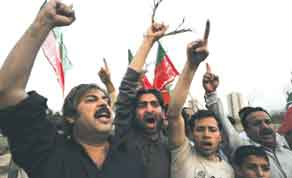
| Activists of Tehreek-i-Insaaf (Justice for Movement), led by former cricket hero-turned politician Imran Khan, shout slogans against the release of CIA contractor Raymond Davis, during a protest in Islamabad yesterday |
“The family members of the slain men appeared in the court and independently verified they had pardoned him (Davis),” provincial law minister Rana Sanaullah told private Geo television.
“He has been released from jail. Now it is up to him. He can go wherever he wants,” he added.
The January shooting ruptured diplomatic relations with the United States, who repeatedly insisted Davis was an embassy employee and enjoyed diplomatic immunity, particularly after it emerged he was working for the CIA.
Lawyers for the families of the two men shot dead in a busy Lahore street on January 27 said they had been held for four hours at the jail court where Davis was being tried yesterday, but had not been allowed to witness proceedings.
“They confined us in the jail for four hours and did not allow us to take part in the court proceedings. We were not allowed to leave the prison,” one of the lawyers, Asad Manzoor Butt, said.
Butt said the families of the men had agreed with authorities to accept blood money over the deaths the previous night.
Another lawyer for the families, Nauman Atiq, confirmed that the lawyers had been held at the court and told not to speak to media.
Blood money, or “diyya” is a provision under Shariah law in which compensation can be paid to relatives of those killed to secure a pardon, and is commonly used to resolve such cases in Pakistan.
The Davis case had sparked protests in Pakistan, with religious groups angrily denouncing the American who claimed he acted in self-defence to fend off an armed robbery when he shot dead the two men.
US authorities insisted Davis was protected by full diplomatic immunity, but the Pakistan government refused to back that claim and a decision on his status was on Monday deferred by the Lahore high court for criminal judges to decide.
Revelations that Davis was a CIA contractor heaped pressure on Pakistan’s embattled government and further ramped up burning public mistrust of Washington, damaging fragile relations between the two wary allies.
A third Pakistani was struck down and killed by a US diplomatic vehicle that came to Davis’ assistance in the January incident.
US officials denied Pakistan access to the vehicle, and the occupants are widely believed to have left the country.
Police have said they recovered a Glock pistol, four loaded magazines, a GPS navigation system and a small telescope from Davis’ car after the January 27 shooting.
Questions swirled around the identity of the victims from the beginning, with some media reports saying the men worked for Pakistan’s Inter-Services Intelligence (ISI) agency, and that they might have been known to Davis.
Other reports suggest they were armed robbers who had already targeted others in Lahore before attempting to rob Davis, tailing him on motorbikes along a congested city road.
The United States postponed a round of high-level talks with Afghanistan and Pakistan following failed attempts to free Davis, and US lawmakers threatened to cut payments to Pakistan unless he is released.