Business

Monday, February 09, 2026 | Daily Newspaper published by GPPC Doha, Qatar.

Business

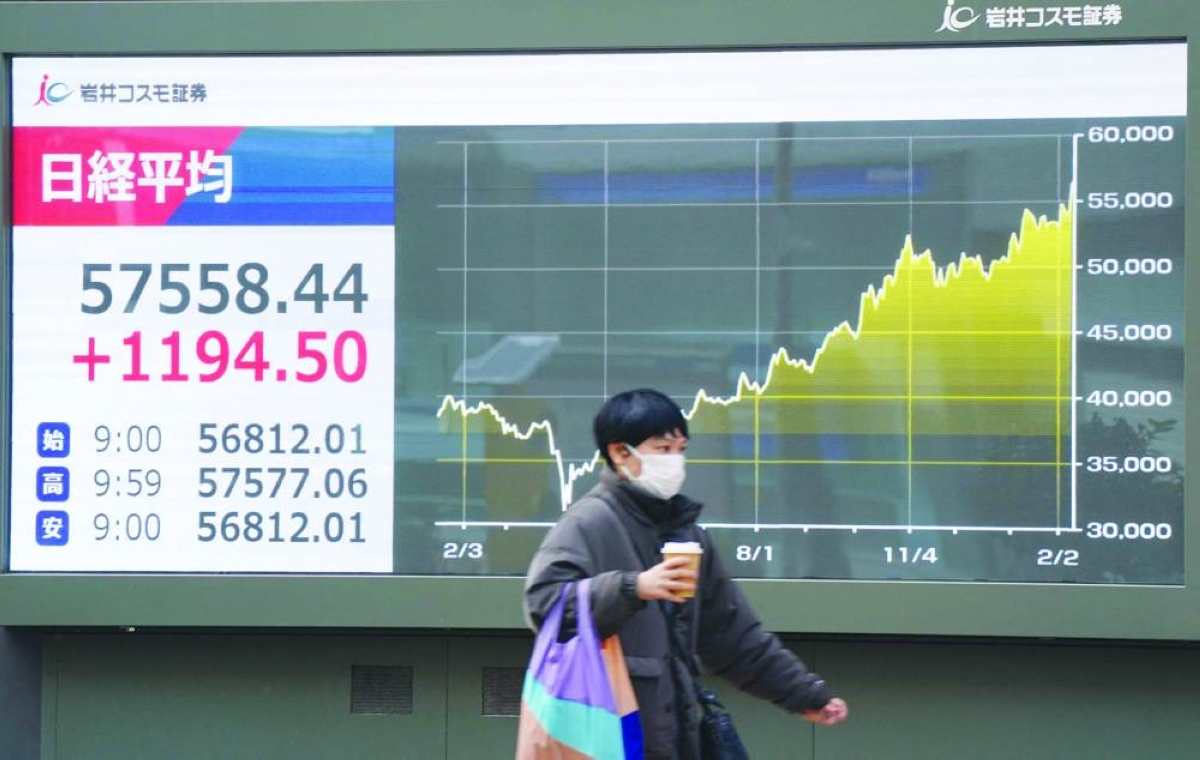
A man looks at an electronic quotation board displaying numbers of the Nikkei Stock Average on the Tokyo Stock Exchange. The Nikkei 225 closed up 3.9% to 56,363.94 points Monday.

Asian markets track Wall Street rally as Tokyo hits record

Japanese stocks surged to a record high Monday following Prime Minister Sanae Takaichi's election win, while healthy gains across the rest of Asia and Europe tracked a rally on Wall Street.In Tokyo, the Nikkei 225 closed up 3.9% to 56,363.94 points; Hong Kong – Hang Seng Index ended up 1.8% to 27,027.16 points; and Shanghai – Composite closed up 1.4% to 4,123.09 points Monday.After last week's broad-based volatility, investors appeared to be enjoying a return to calm, with the news out of Tokyo providing hope for political stability in the world's number-four economy.Takaichi's resounding victory saw her ruling Liberal Democratic Party take around a two-thirds majority of the lower house, paving the way for increased fiscal stimulus and massive tax cuts."We will prioritise the sustainability of fiscal policy. We will ensure necessary investments. Public and private sectors must invest. We will build a strong and resilient economy," she said Sunday as the results rolled in.Analyst Kyle Rodda of Capital.com said the ruling Liberal Democratic Party's victory had handed Takaichi "the mandate she was looking for for her big-spending agenda".Equities are "poised to benefit from higher fiscal spending but interest rates that remain accommodative and negative in real terms", he said."A decisive victory is typically a near-term positive for markets because it reduces political uncertainty and can add a 'certainty premium' – investors can price policy direction with more confidence, rather than worrying about fragile coalitions and legislative gridlock," said Charu Chanana at Saxo Markets.But she said the medium-term was a little more nuanced."A landslide can embolden a bigger fiscal and security agenda – more spending ambitions, more active defence posture, and potentially more geopolitical friction."But the same landslide can also create room for pragmatism: with her position secured, Takaichi has less need to campaign from the edges and more incentive to protect approval by moderating the most market-sensitive policies."Financial markets may also be nervous about Japan's public finances and its gargantuan debt pile if Takaichi decides to cut taxes and boost spending.But for now investors are upbeat, pushing the benchmark Nikkei 225 index more than five percent higher at one point to break 57,000 points for the first time, before paring the gains to end 3.9% higher. The yen also advanced."From a market perspective, the outcome is strongly supportive for Japanese equities... as Ms. Takaichi now has broad flexibility to pursue her pro-growth economic agenda and advance structural reforms," wrote David Chao at Invesco."Overall, the combination of political stability, policy continuity, and reform optionality is likely to be viewed positively by markets, reinforcing the constructive outlook I continue to have for Japanese risk assets."Elsewhere, Hong Kong, Shanghai, Sydney, Singapore, Mumbai, Jakarta and Taipei all enjoyed strong buying.Seoul climbed more than four percent, helped by a six percent jump in market heavyweight Samsung after a report said it would start mass production of its next-generation HBM4 memory chips.Bangkok added more than three percent after a stunning election victory for caretaker premier Anutin Charnvirakul's conservative Bhumjaithai Party that boosted hopes for political stability.London, Paris and Frankfurt opened in positive territory.The gains came after all three indexes on Wall Street ended last week on a positive note, with the Dow topping 50,000 points for the first time as traders focused on the prospects for the US economy and possible interest rate cuts.However, there remains a lot of uncertainty over the tech sector, which has been hit by worries over the vast sums being invested in AI and when – and if – they will see returns.Precious metals edged up as they also enjoyed a return to stability after last week's ructions. Gold was sitting just above $5,000 and silver was at $82, having seen wild swings from record highs of $5,595 and $121 to lows of $4,402 and $64.Oil prices edged down one percent on easing geopolitical concerns after Iran and the United States held nuclear talks in Oman, with Tehran calling the meeting "a step forward".Bitcoin fetched around $70,500, having bounced back from a plunge to just above $60,000 during last week's ructions.

Traders work on the floor of the New York Stock Exchange. A closer look at the equity landscape shows cracks still exist, prompting investors to pay up for protection against further downside.

Wild week of trading leaves pockmarks across US equity landscape

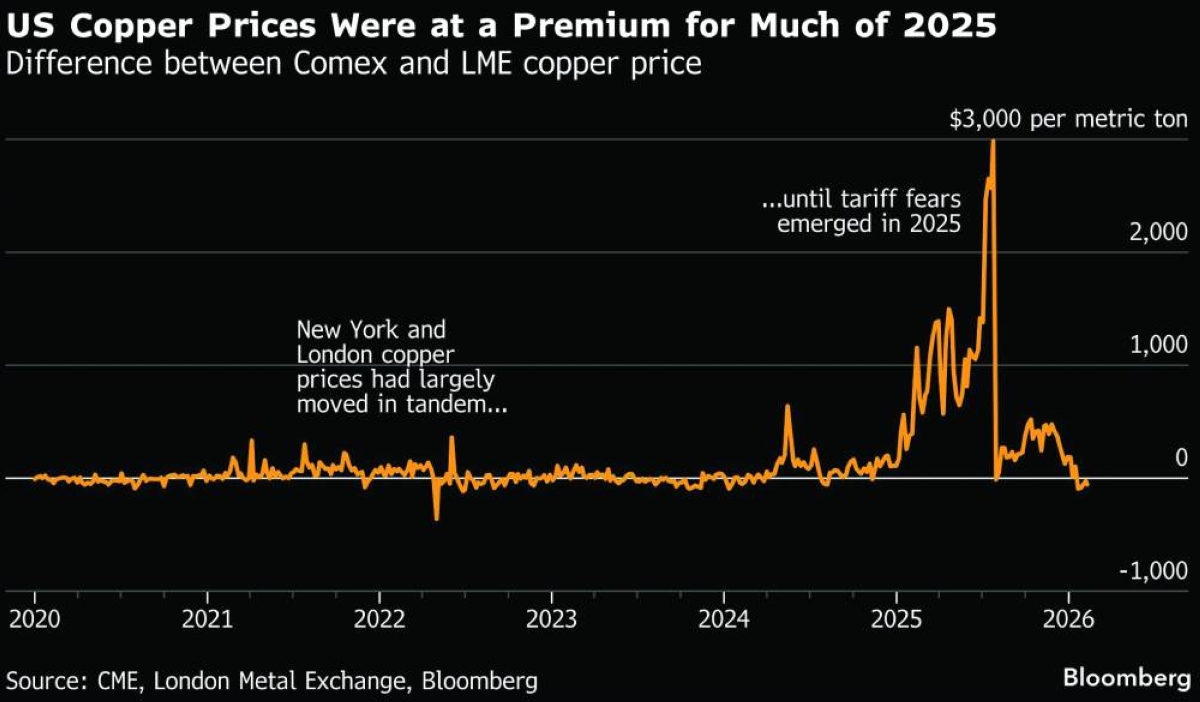
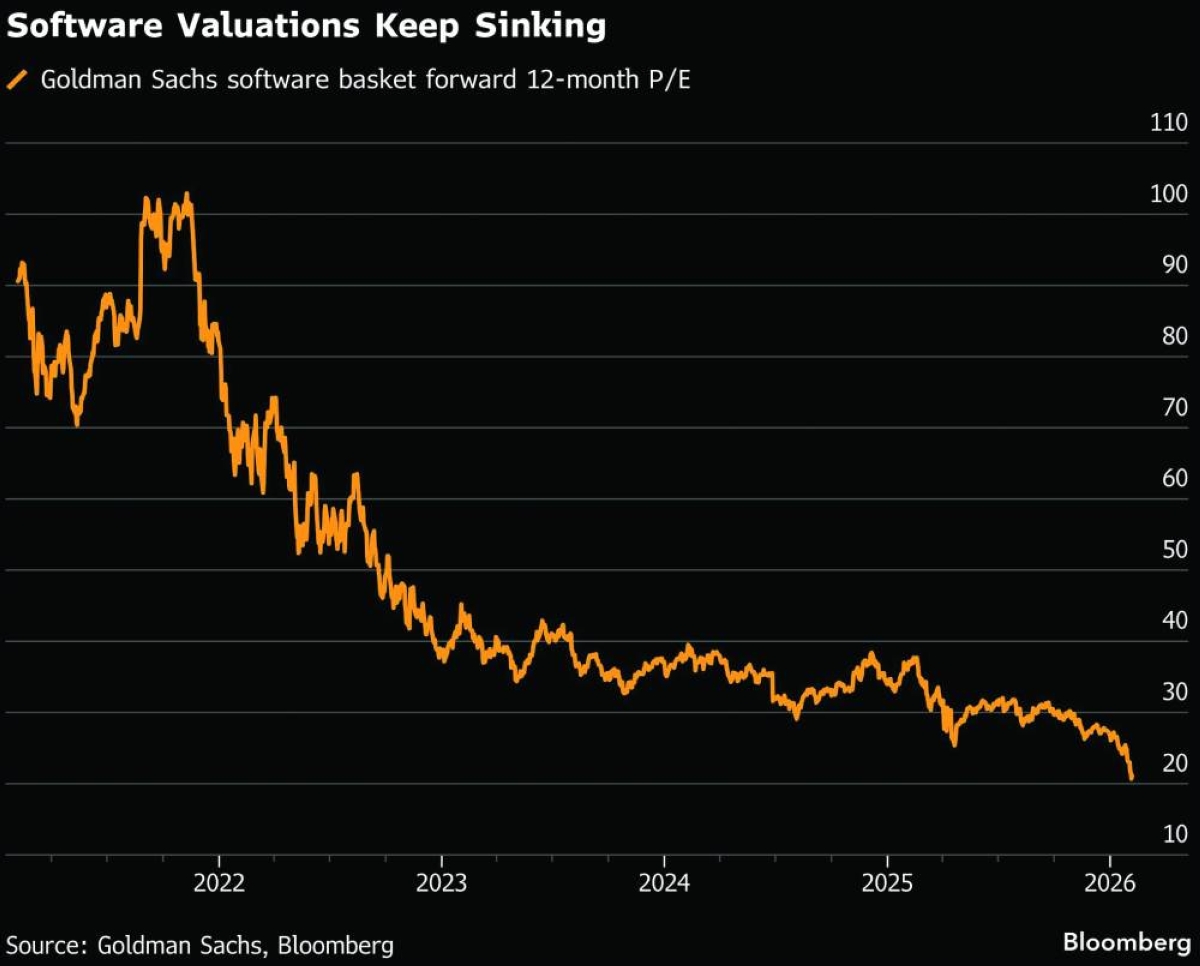
Precious metals memed out, Bitcoin flamed out and the labour market looks like it’s petering out. None of it started in the equities market, but together it was enough — along with a reckoning for software firms — to shake the foundation of an AI-driven bull run.Friday’s rally pushed the S&P 500 back to breakeven for the week. Still, such rallies in the aftermath of broad-based selling tend to occur in times of prolonged stress. And a closer look at the equity landscape shows cracks still exist, prompting investors to pay up for protection against further downside.“When investors get nervous, it’s often the most stretched areas of the global financial markets that feel the pain first,” said Mike Dickson, head of research and quantitative strategies at Horizon Investments.The tumult that earlier in the week wiped out more than $1.5tn in value from US equities left investors questioning some underlying assumptions. Is the economy really strong enough to support another year of double-digit gains? Will AI’s promise of productivity gains instead wreak havoc on entire industries? Are retail traders distorting markets, turning havens into hazards?The uncertainty sent software stocks on the wildest ride, but they were hardly alone. Momentum stocks, mostly big tech, suffered the worst one-day rout since the pandemic. Miners went for a violent spin with gold, silver and copper prices tracing charts reminiscent of the meme-stock frenzy. And companies that popped up to plug into the Bitcoin craze got iced by the latest crypto winter. Even consumer stocks, relative winners in recent months, got hammered.“There are a lot of pot holes out there that are turning into sink holes for some assets and sectors,” said Thomas Thornton, founder of Hedge Fund Telemetry LLC.Here are the sectors, stocks and themes beyond the software selloff that still look vulnerable after the past week’s downs-and-ups.Small caps: The year started with investors rotating from tech, where valuations had become stretched, into companies that benefit from an upswing in economic growth and falling interest rates. Chief among their targets: Small caps.That bet soured in the past week, partly because investors left few corners of the market unscathed. The main problem, though, came from a trio of labour-market data points that showed worrisome weakness in the American economy. Small caps get a disproportionately high percentage of sales at home.The threat to employment from AI also weighed on the sector, with small financial and tech companies most vulnerable to disruption. Suddenly, the Russell 2000’s 7.6% advance to start the year looks too optimistic.“The equity market could be sniffing out mounting pressure on consumers, as labour market data continues to cool,” said Cameron Dawson, chief investment officer at NewEdge Wealth.A surprisingly strong consumer sentiment reading on Friday stemmed the selling, but not before the Russell 2000 fell more than 5% from its most recent peak.Meme-like metals: The moves in the price of gold and silver, up and down, have been anything but normal. Naturally, the companies that mine them have been along for the ride.Newmont Corp, the largest gold miner in the US, doubled in 2025, while some smaller miners like Discovery Silver Corp soared 1,000%. The trade is unwinding rapidly. The VanEck Gold Miners ETF dropped 13% on Jan. 29, the most in over five years. Despite rebounding sharply thanks to gains Friday, the fund and the space are suffering from what Horizon’s Dickson called a lack of “strong fundamental support.”The metals have “transformed from boring commodities traded by professionals into exciting gambling instruments traded by retail investors,” Owen Lamont, senior vice-president and portfolio manager at Acadian Asset Management LLC, wrote. “Forget meme stocks, we’ve entered the age of meme metals.”That’s alarming for investors trying to play gold miners as a port in turbulent times. Double-digit daily and weekly moves simply don’t comport with a risk-averse profile.The trade has gotten “nutty”, said Sameer Samana, head of global equities and real assets at the Wells Fargo Investment Institute. “Almost every theme has been taken to the nth degree and gold and silver are not an exception.”Canada’s benchmark equity index is loaded up with metals miners and has dropped more sharply than its US counterpart in the past week. The S&P/TSX Composite Index has a 14% weighting to gold miners — a percentage that might increase after a planned rebalancing that could add up to nine gold companies, owing to their strong performance in 2025, Scotiabank analyst Jean-Michel Gauthier wrote Thursday. DATs: Digital gold fared even worse than the metal, effectively rendering obsolete the moniker given to Bitcoin by its legions of fans. In the stock market, Bitcoin miners and so-called digital asset treasury companies — most notably Strategy Inc. — took it on the chin.Strategy plunged 9.9% this week as Bitcoin tumbled past $65,000 to the lowest in more than 15 months. Its holdings have an average cost basis north of $75,000. Other copycat DATs, like Metaplanet Inc, MARA Holdings and DeFi Technologies, also fell.Companies that allow investors to trade crypto also got rocked. Galaxy Digital Inc and Coinbase Global Inc all fell more than 20% this week. The largest ETF that tracks Bitcoin sank 16%. ECM trouble: As software firms like Docusign Inc, Salesforce Inc and Workday Inc plunged on concern AI tools could obviate their businesses, investors started scouring other parts of the economy where back-office proprietary code could get disrupted by robots.There are a lot to choose from, going by Conference Board report from October that said 72% of S&P 500 companies have updated disclosures to say AI poses a “material risk” to their business. Banks, travel stocks, professional services providers and the entire small cap sector are under scrutiny.Equity capital market activity, from dealmaking to IPOs to share and debt sales might slow if AI’s disruption becomes destructive. Tech M&A was up 77% last year and was expected to contribute meaningfully to bank’s capital market divisions again this year, Truist Securities analysts including Brian Foran wrote in a Thursday note.“A couple of bad weeks of trading doesn’t necessarily derail that — but it doesn’t help,” he said. Positioning in the software sector remains bearish, which is raising concerns of a spillover.Beyond banking and financial services, investors also see the fallout from a software rout extending to professional services more broadly. Already, stocks like Thomson Reuters Corp and Morningstar Inc plunged by double digits this week. (Bloomberg LP, the parent of Bloomberg News, competes with Thomson Reuters and Morningstar in providing financial data and news.)“Do I want to hire an outside company, or do I want to AI do some of that?” said Keith Lerner, chief investment officer and chief market strategist at Truist Advisory Services Inc.He sees firms offering services like online education, media and advertising, outsourcing and market research as having revenue streams that could be strangled by AI. Online education company Chegg Inc has fallen 15% year to date while peer Coursera Inc has fallen 20%.